Willow and I were first in the mountains then down the lake, on the west side, anticipating the return of the galactic centre. Willow barked at the coyotes yipping. An owl started up somewhere behind us, then was quiet, maybe busy filling it’s belly with an unlucky vole.
The Milky Way curved from north to south. The stinger of Scorpius glowed red, a smear of greenish northern lights, turning magenta over the Giant Chief Nutmuq¢in.
An imagined glacier under foot. Even Willow bought into my tall tail, and gave me the cautious look of, let’s not fall through. You worry to much old hound, just the same, there is coffee an’ a muffin waiting. Plus we had our proof, spring is really on its way.
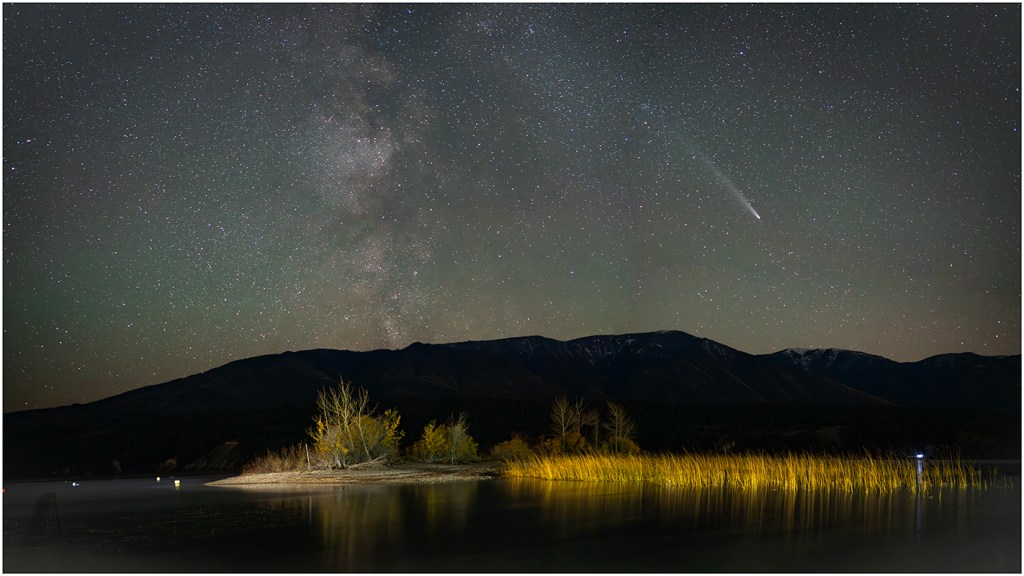
Comet Tsuchinshan-ATLAS is seen to the right of The Milky Way.
Stayed up past bedtime for another crack at seeing Comet Tsuchinshan-ATLAS. It was more difficult to pick out, but with a little squinting I found it in a much higher position than the last time we spotted it. Without dark clear skies it would have been impossible to see.
The comet is racing away from us, back to the Oort Cloud, and getting dimmer and smaller by the day.
I took quite a few photos on different camera settings. Once I go through them I will share more here. The photo above is a panorama of six shots stitched in Adobe Lightroom. It was taken on a much higher ISO than I usually use for astrophotography, but was necessary with the lens I was using. Well worth losing some sleep over.
The tail of Comet Tsuchinshan-ATLAS extends above the cloud cover.
We have been battling the clouds but was able to get one picture of the comet tonight. It is not the greatest picture due to having my camera set wrong. It does show its long spectacular tail.
Comet Tsuchinshan-ATLAS is rising in the sky, providing we get some clear skies there should be more opportunities to see it.
It will be very interesting to see how it interacts with the waxing moon.
Comet Tsuchinshan-ATLAS has now emerged from the glare of the sun to become an evening comet.
Once again it was Lisa’s eagle eyes that was able to spot it just as we were about to give up. From our vantage point it was beside Mt. Nelson.
The photo was taken with a very wide angle lens, the same one I used to take the auroras, and the crop is a small part of the frame. If it is clear tomorrow evening I may give it another try with a lens that will make it appear closer.
It is always rewarding to spot comets, they are often a challenge. Comet Tsuchinshan-ATLAS may become easier to see as it rises into a darker sky. As it does, however it will quickly fade as it moves further away from earth on its journey back to the Oort Cloud. In 80 thousand years it will return.
An array of colours along the path of The Milky Way. This is ten photos stitched together in Adobe Lightroom. It spans from North to South looking East.
Tried again, this morning, to spot Comet 12P/Pons-Brooks. This comet could be beyond Willow’s and my ability to track down. It is very close to the horizon beside the Andromeda Galaxy. By the time it rises above the mountains the sky is losing darkness. Also, we haven’t had super clear skies and the thickest haze is always closest to the horizon. That haze is in fact pollution. That’s why many cities have beautiful sunsets.
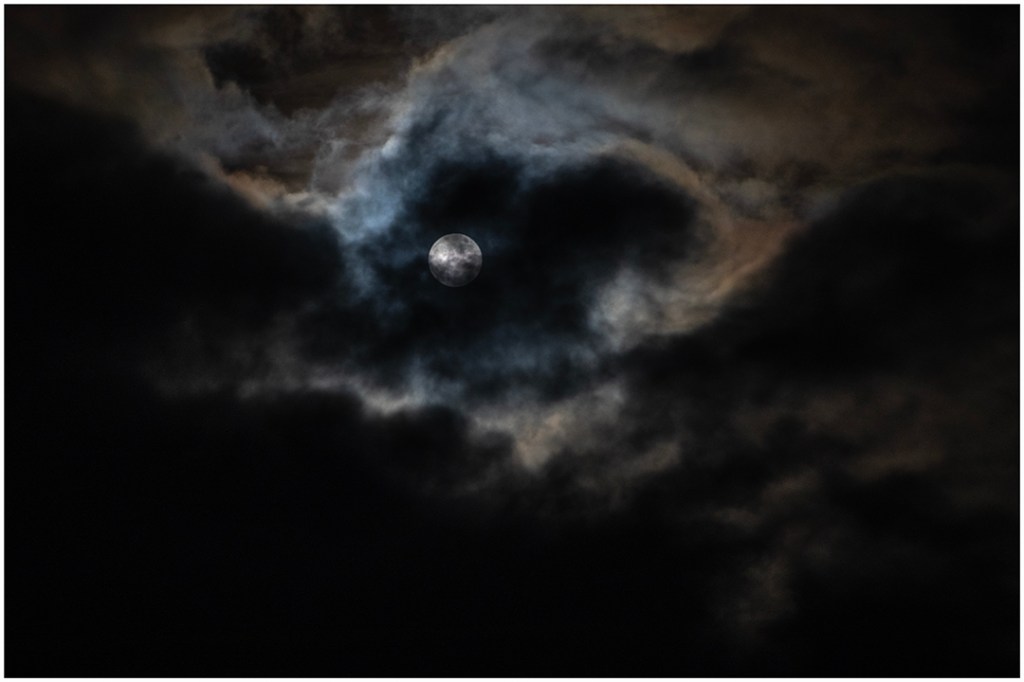
The moon as it appeared just after dark.
It is funny in a ridiculous way, our summers are filled with smoke from forest fires, now the spring and fall also has it’s share of smoke, as the provincial government and logging companies burn slash piles. Slash piles are all of the waste wood left over from clear cut logging. There is a lot of waste; branches, rotting wood, stumps, small trees, basically any mess the companies leave behind is pushed into piles and set ablaze.
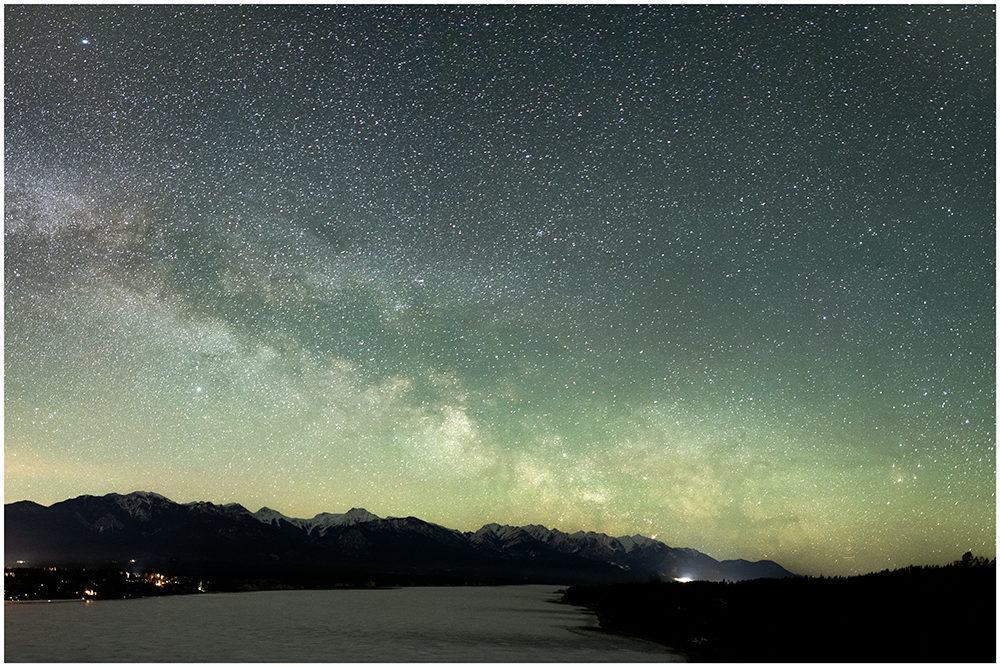
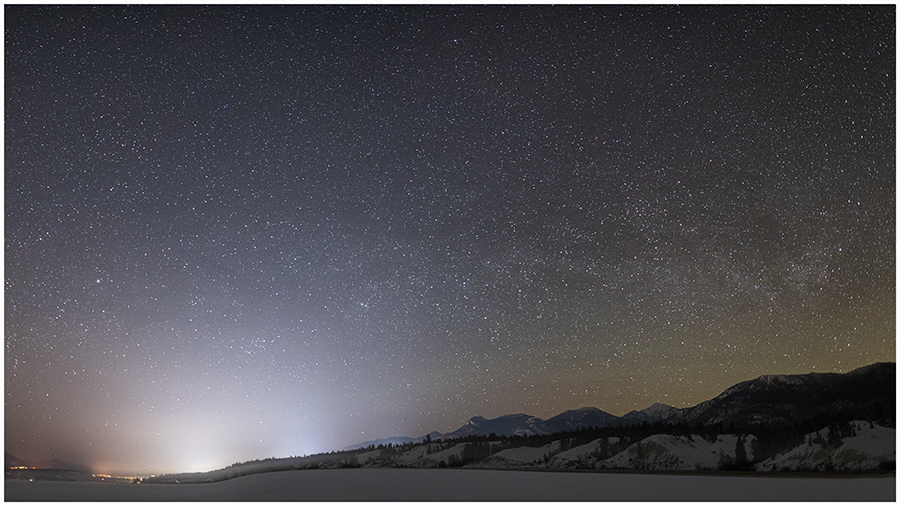
The core of The Milky Way returns signalling spring and the coming summer. The green haze is a combination of haze, light pollution and maybe even some stardust. Lake Windermere still has its layer of winter ice.
It would be interesting to know if these C0 emissions are counted as industry emissions or if they get tabled under forest fire emissions. The latter not counted towards Canada’s yearly emission targets. Regardless, it is another case of the government saying one thing and doing another. The entire valley could drive around in Diesel Ford F350s for years and not emit the pollution that one of these massive slash piles produce.
I don’t think there is any big conspiracy involved, I just think government is incompetent in this regard.
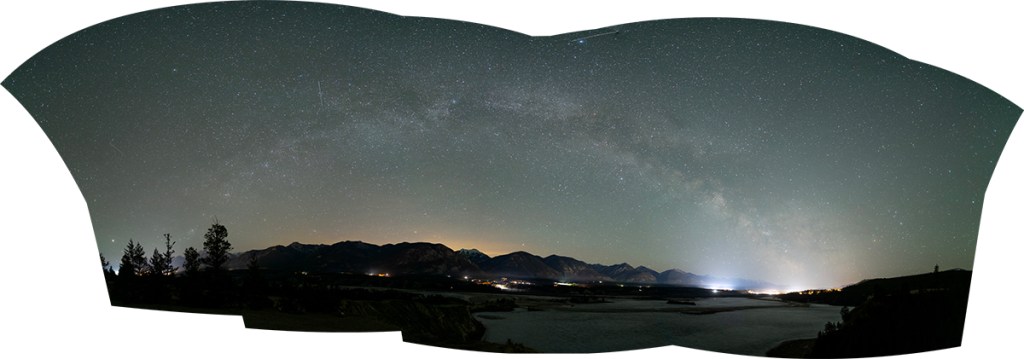
This is how a panorama looks when I am stitching it together. This is ten individual photos taken left to right with overlap. This image is five frames wide and two frames high. The lens used was 20mm, which is wide, so a lot of the sky is captured. I did not do a very good job of keeping the bottom of the photo even. It can be difficult as it is dark and I can not see through the viewfinder, so it is done by feel. The bright lights in the distance is Invermere.
Colour in the sky. The Milky Way will start rising in the coming months, first parallel to the the valley bottom, slowly turning straight up and down. Six satellites can be seen in this photo. It’s tough to get a photo without them showing up.
It is not often the cold is too much for Willow and I. Perhaps it is that we aren’t used to it, it having been a mild winter.
We headed for the south end of the lake. It surprised me that it dipped to -31°c. I took a few pictures but wasn’t really into it, my hands freezing on the aluminum tripod legs. Willow whined when we stopped to take photos.
Looking back towards the lights of town. The curve of the shoreline is due to the Space-Time Warp continuum. Just kidding! It is caused by sewing multiple images together to form a panorama.
I spotted Comet E3 ZTF and took a photo, however not that interesting as I had to point the camera almost straight overhead. It would be nice to try to take a photo with the 200mm lens, but I would need a sky tracker.
A fog started to roll in hastening our departure. The last thing I wanted to do is depend on a compass to find our way off the lake.
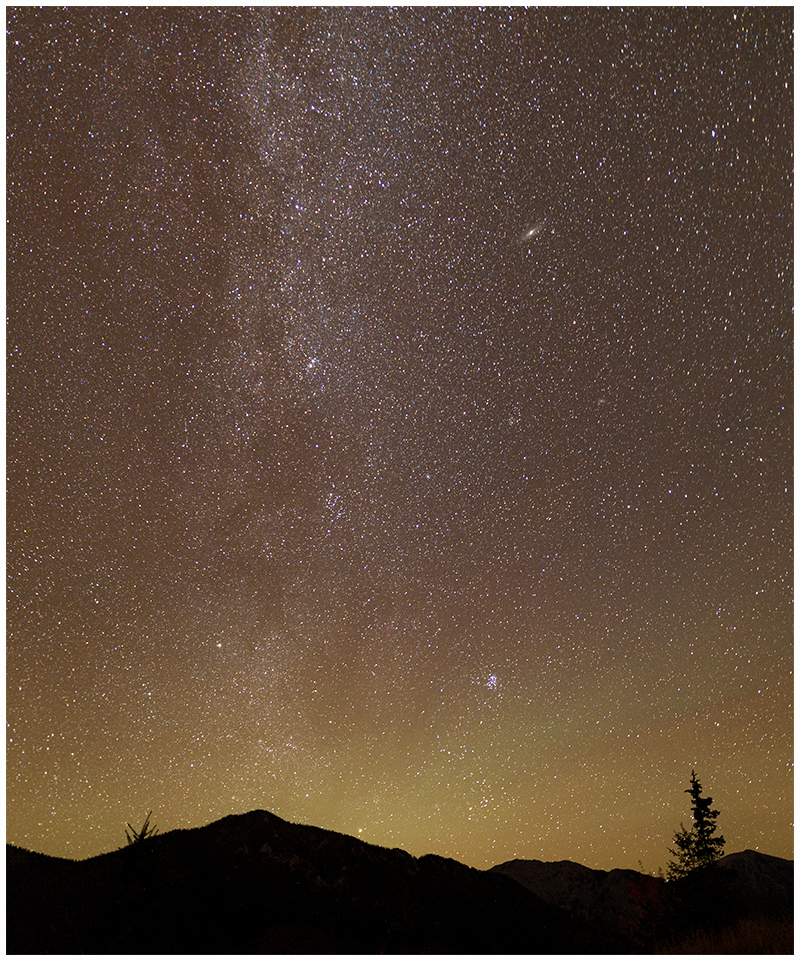
Starting from the top; Cassiopeia, Andromeda, The Andromeda Galaxy, Perseus and its two star clusters, also Pleiades, Taurus and Mars just coming over the mountain Ridge.
To look at the stars is to be amazed. In this day and age we know the science of astronomy. We know distances and the difference between planets and stars. You can steer a ship, plant a garden and set our calendar by them. If we have something in common with every generation going back to the beginning of man it is the stars. To look at the stars among the trees and mountains on a dark night, to feel those pin pricks of light flow through, as they have done and will continue, is to feel lucky.
Willow and I were up early for a walk under the stars. It has been clear for awhile, unfortunately we picked a morning that was cloudy with a few stars poking through here and there.
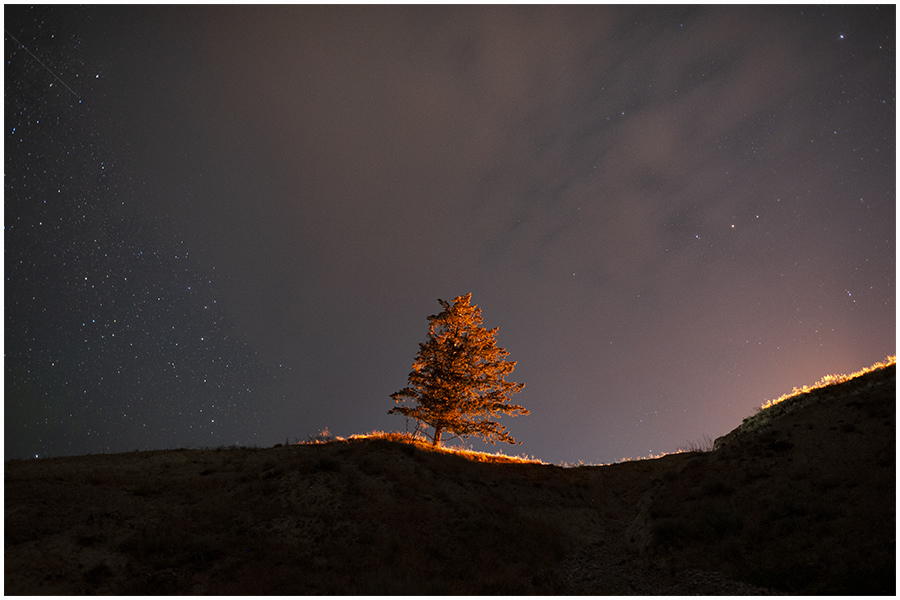
Using the lights of the Valley bottom to illuminate the trees. Pleiades and Mars can be seen above the trees in the centre.
Willow decided to drag her face through a patch of burrs and is now covered in them. She has been patient but not overly pleased with me picking them out.
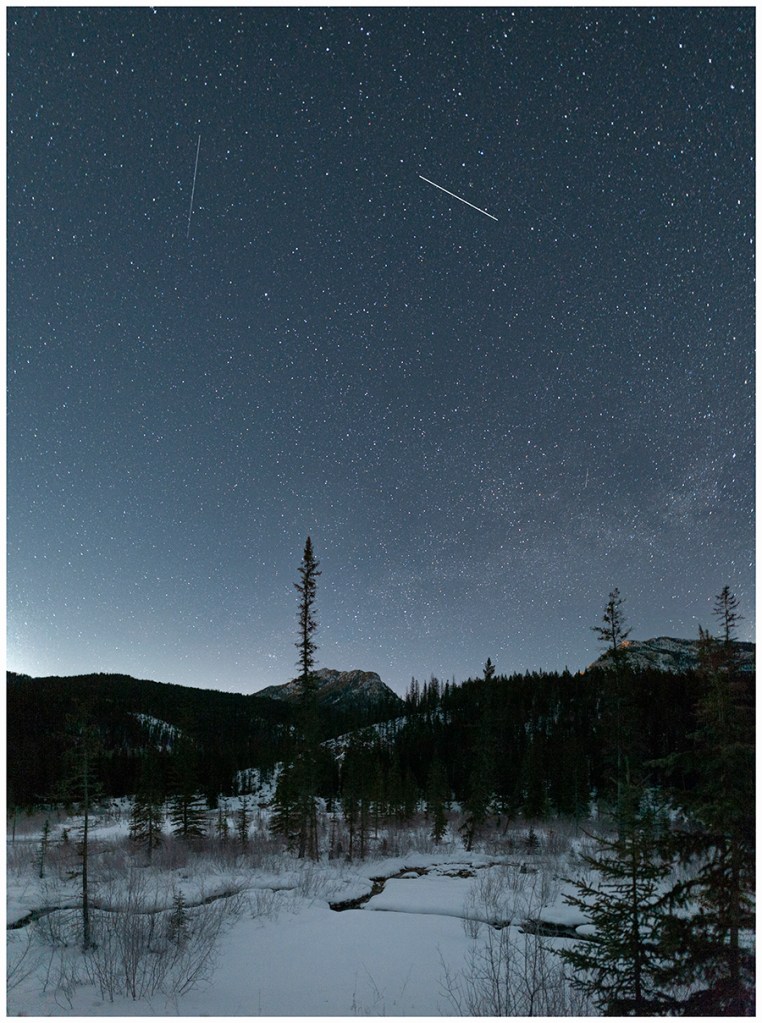
I mentioned satellites in my last post with one 15 second exposure capturing five. This has become normal with more and more satellites being launched every month.
It used to be exciting to see a satellite when they were rare. Now it seems you can’t look up with out seeing them. I prefer my stars not moving or streaking in photographs.
The night sky is primal to humans, it is embedded in our DNA. We have lost our view of stars due to earth based light pollution, with many people around the globe never seeing The Milky Way. I can’t help but think we are now well on our way to polluting the sky from above.
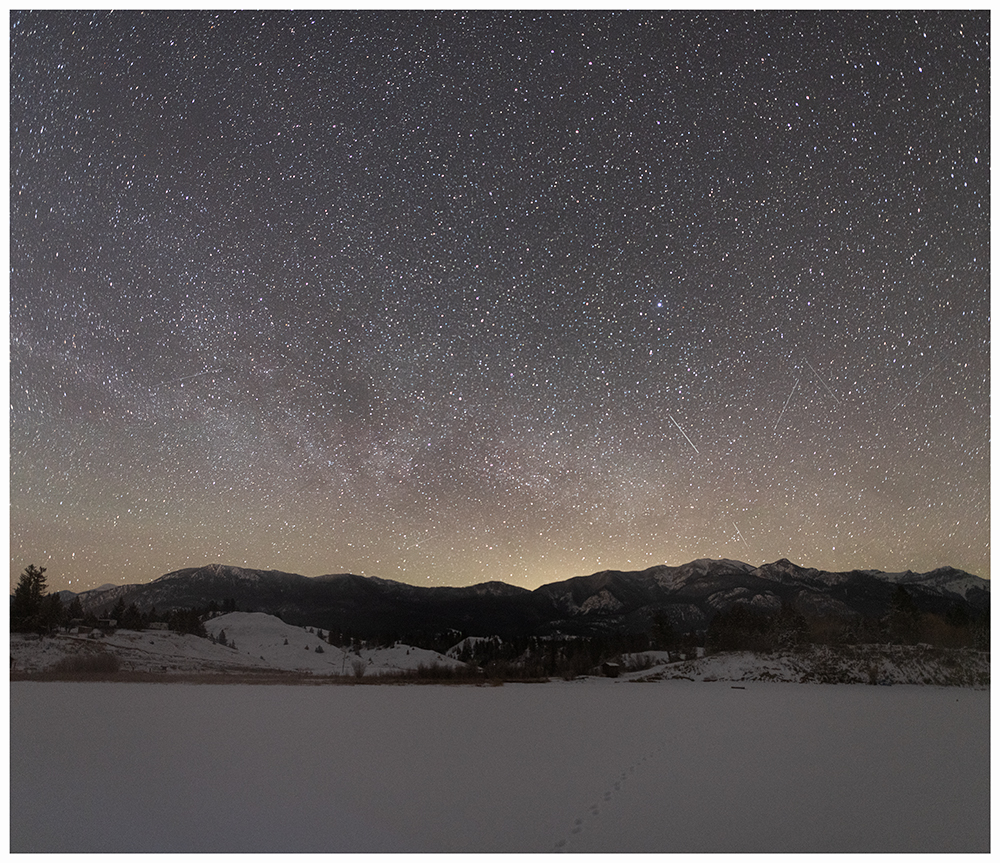
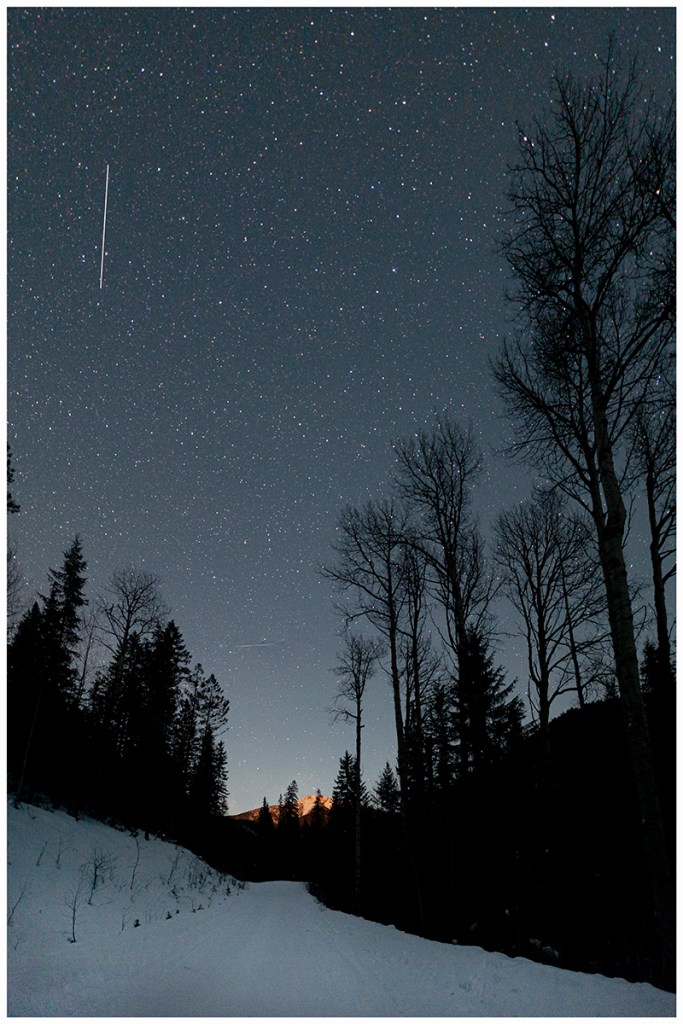
Two satellites. The last of moonlight catches the top of a mountain.
Regardless of our advancements in space exploration, which are phenomenal, our lose of vision to the stars will have consequences for humankind. Maybe it already has.







 Palliser Pass