Eclipse

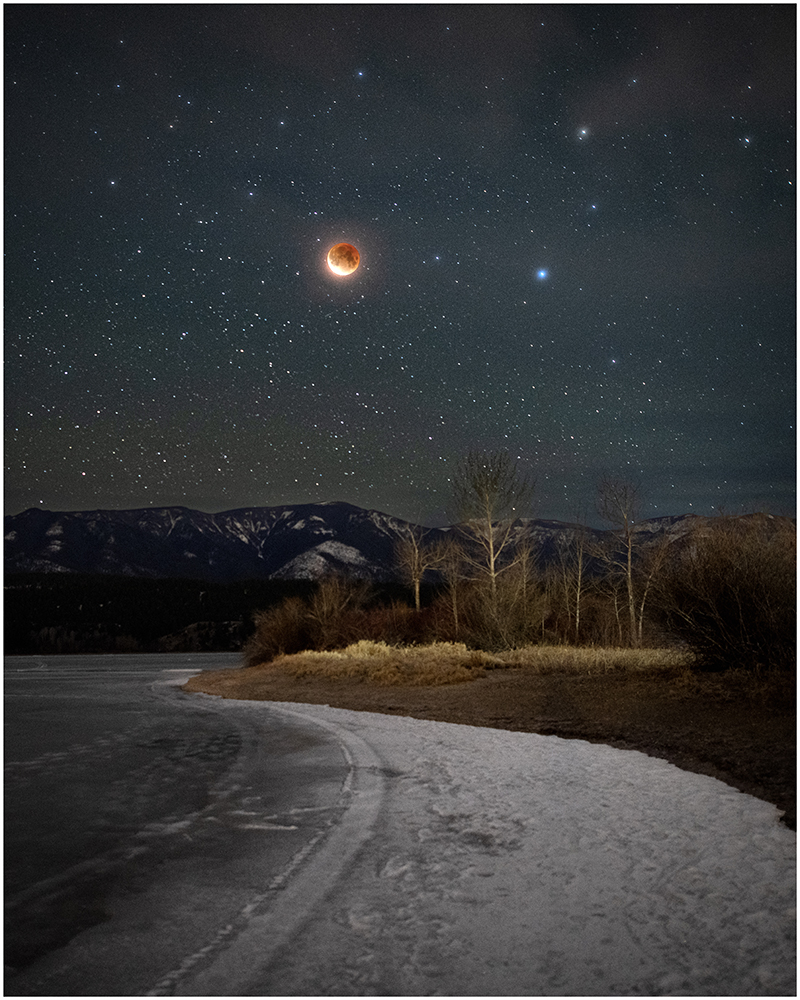
We were very fortunate to see the lunar eclipse on the morning of March 3rd, especially considering how cloudy it has been this winter.

I have included another photo from that night. Photographing the moon can be difficult. If you expose for the moon, the landscape often turns out very dark. If you expose for the landscape, the moon becomes completely blown out. I have always preferred photographing the moon in a blue sky at dusk or dawn. Doing so allows you to choose an exposure that works for everything in the frame.

I try to keep my astrophotography simple. Most of my images are single exposures. Occasionally I will take multiple images to create a panorama when I want to show more of the scene than a single frame can capture.

During this eclipse, however, I did something very common in astrophotography: I took two exposures of the same scene—one exposed for the moon and one for everything else. This allowed me to capture detail in the moon without it being blown out. I achieved this by adjusting the ISO and shutter speed between shots. In Photoshop I stacked the images and used masking to combine the best parts of both exposures. It is a bit of a trick, and I admit I feel somewhat guilty for doing it.

This method is widely used. Photographers often take many exposures of the sky to reduce noise, along with separate exposures for the landscape and the stars. The images are then aligned and processed in Photoshop to create a polished final photograph. The Milky Way can really pop when this technique is used.

However, this approach isn’t really for me—not because I believe there is anything wrong with it, but because it requires more concentration and planning than I enjoy when I’m out photographing. I prefer to roam around with my camera, capturing single shots as I go.

There are also many photographers now using AI in astrophotography. For me, these images are usually easy to spot and make up a large portion of astrophotography found online. They can be striking, and again, there is nothing inherently wrong with these methods. I know of several landscape photographers who place the Milky Way above well-known mountains in directions where the Milky Way never actually appears. The images sell well for them—and why not?

Perhaps it is because I grew up in a newspaper shop that my instinct with photography is to document. I try to make the best photograph I can with the equipment I have, paying attention to composition, colour, and the rule of thirds. But in the end, what I am really trying to capture is a place, a moment in time, and an attitude—something that may not exist in quite the same way in the years ahead.
Lunar Eclipse

Rolled out of bed early to get a look at the eclipse. Once in full eclipse it was brilliant red. It is intriguing as it goes from full moon to eclipse. Once the moon is in the shadow of earth the stars come out. Including the rising Milky Way in the east.

This is a quick picture. This is the first time taking a lunar eclipse with a higher resolution camera. I will look over the rest of the photos in the next day or two.

Willow would have really enjoyed the morning. So strange without her keeping the perimeter.

Clear

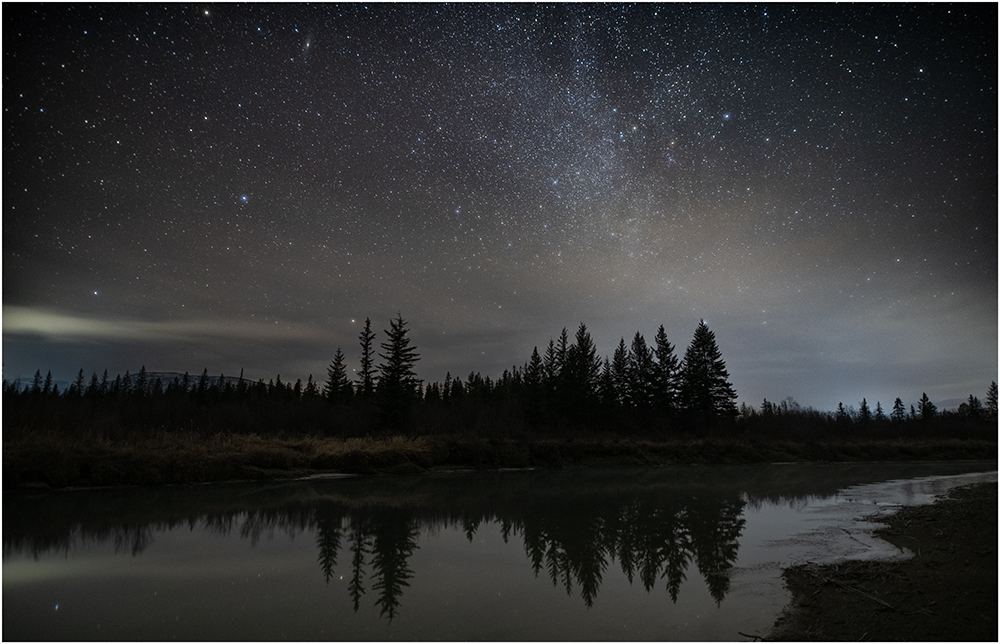
Along the great Columbia River where it starts as a trickle.

The first clear night in a long while. Warm weather in winter is usually accompanied by cloud and we have had our share.

It’s tougher to stay up late for Willow and I. We had intended to head into the mountains. But the thought of breaking through snow to the knee stopped me. Willow would have been okay. The warm weather softened the snow, with the cooler weather putting a hard crust on the surface, but not enough to hold me.

We stuck to the valley bottom. And headed for the source of the Columbia River. The warmth has robbed the ground of snow and has left a layer of ice. I walked carefully. I could hear Willow’s nose going constantly. She is slowing down, grateful for the smells that still cause a wag and bark.

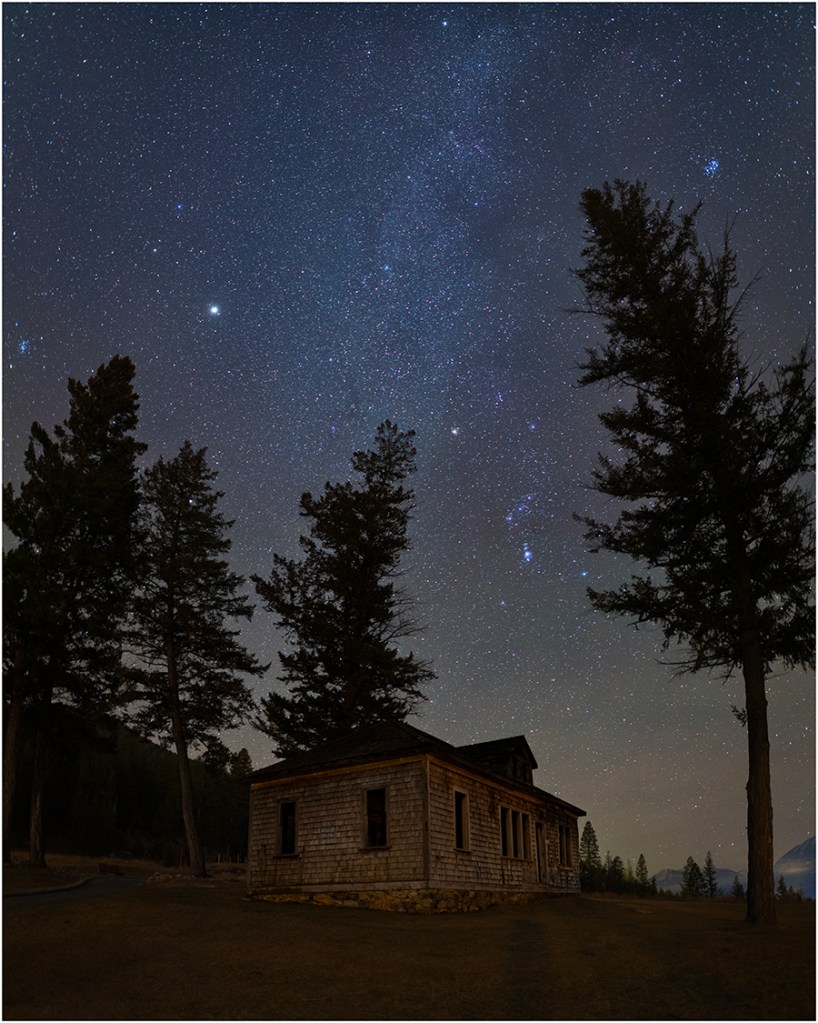
The Old Geary Place with Orion standing guard.

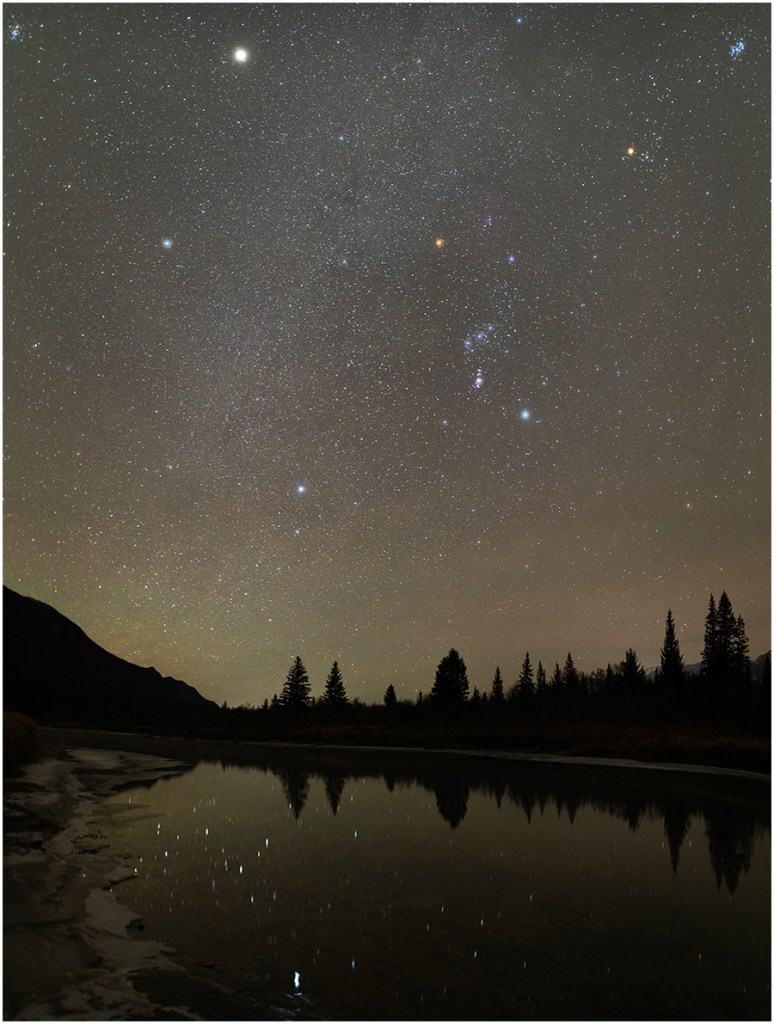
The winter stars were out in force. Orion ruled the dim end of the Milky Way, Sirus twinkled so much when I caught it in the corner of my eye I thought it was a falling star. Jupiter shone bright above the great chase.

To see it in force, while I try to make sense of it all, knowing all along it’s all a best guess is somehow comforting.

A fine night to count the stars.

Winter stars and Jupiter. The Beehive Cluster in the top left corner and the Pleiades Cluster in the top right corner.

Winding Down

Finally a good layer of ice on the lake. Providing there is no snow tonight, Cooper and I will be heading down for a skate. We will have a few pucks to toss back and forth. We might even take the net. You learn fast if you miss it you have to skate a long ways to retrieve the puck.

It’s good to feel the cooler temps.

Fading

Comet Lemmon, you are going to have to take my word for it!

C/2025 A6 (Lemmon) is quickly fading from view. Since it was clear Willow and I thought we would give it one more go to spot it.

This time I took my 20mm wide angle lens knowing that if the comet could be seen it would appear very small in the photos. This is the lens I am most comfortable using for night photography because it gives such a large view of the sky. It also allows me longer exposures before the stars streak.

The sun went down and the full moon came up behind us. It dipped quickly to -4°c, which felt chilly. I am going to have to toughen up if I plan on making it through winter. We walked around where Slinky and Ara are buried. It is truly a beautiful spot. As the sky turned blue and darkened we spotted flashes of white as we jumped several White Tailed Deer. They were quick not to stick around. It reminded me of hunting with Dad. Seeing the best game when it was too dark to shoot. Both because you couldn’t see the far sight on the rifle, and more importantly, it’s against regulations.

The full moon illuminated the mountainside. Only the brightest stars could be seen. Of course, the moon also washed away the comet. Still I had faith and pointed the camera in the general direction of where it should be.

Moonlit night.

Both Willow and I were glad to get back to the warmth of the truck. We picked our way along the back rounds, through frozen puddles, staying the best we could above the ruts. Such a pleasure in my life to putter along old and overgrown roads. I used to do it with a beer in my right hand, now it’s a coffee if anything. We stopped at the lake. It was calm and the moonlight reflected the mountains. I listened for fish jumping. Willow heard something and gave a bark. Her echo barked back at her and then the barking match was on. Willow looked at me seriously, ‘there is another dog out here’.

Time to head back to the valley bottom and the warmth of bed.

An enlargement of the top photo. Due to moonlight, even blown up, Comet Lemmon is hard to spot.

Comet Hunting

Tried to peek through the clouds to get a glimpse at Comet Lemmon. It hasn’t been easy with clouds rolling in just as it’s been getting dark, however thought I’d give it a try regardless. You’ll never catch fish if you don’t put your line in the water.

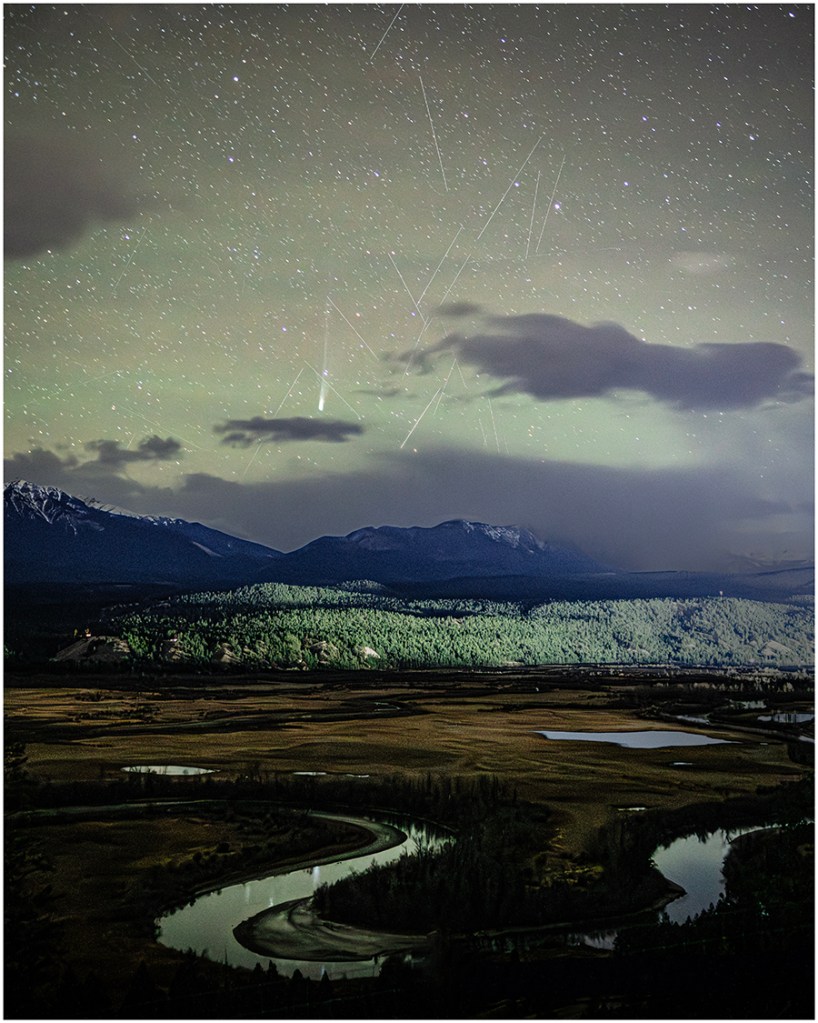
As the clouds parted I was able to easily see the comets nucleus. In the photo you can even see it reflected in the river. The tail was harder to see. The camera picked it up nicely even amongst the light pollution of the Village of Radium Hot Springs.

Just a word about light pollution; it was interesting to have been in Waterton recently and saw how they have tried to limit light pollution. They are part of a dark sky reserve and it is important to them. In the Windermere Valley light pollution gets brought up occasionally but never gets much traction. The only way it ever will is by showing decision makers that there is some profit in shining lights down. That is a tough sell in a valley growing as fast as this one.

Speaking of pollution, notice the ‘scratches’ in the sky around Comet Lemmon. These are Starlink satellites. It is amazing and annoying how many are in low orbit around the earth. It is almost impossible to look into a darkened sky without seeing them now. This is only going to get worse as Starlink continues to launch thousands more and other countries and companies begin to launch their own version of Starlink.

Without regulations or common sense it may become impossible, in the future, to enjoy the stars, meteor showers and visiting comets, as the night sky fills with streaking satellites. Humans should be ashamed of polluting the atmosphere, oceans, water and land, instead of giving it a second thought, however, we have moved onto corrupting the space and stars above us.

I would still like to get a better look at Comet Lemmon, but my chances are limited as it gets closer to the sun and our weather fails to improve.

C/2025 A6 Lemmon

Comet Lemmon (upper left) seemingly following the same trajectory as a satellite.

Nice brisk morning at -6°c. Willow and I went out at about 5:30. It was just starting to lighten around the mountains in the east. The waning moon was bright to the southeast. I pointed the camera in the direction of where Comet Lemmon should be located as I wasn’t able to spot it with my naked eye. Later when I was home I was able to easily locate it on the downloaded photos. Now that I know where to look it will be easy to spot next time out. And it should get brighter!

Comet Lemmon in relation to the Big Dipper.

Thanksgiving Weekend

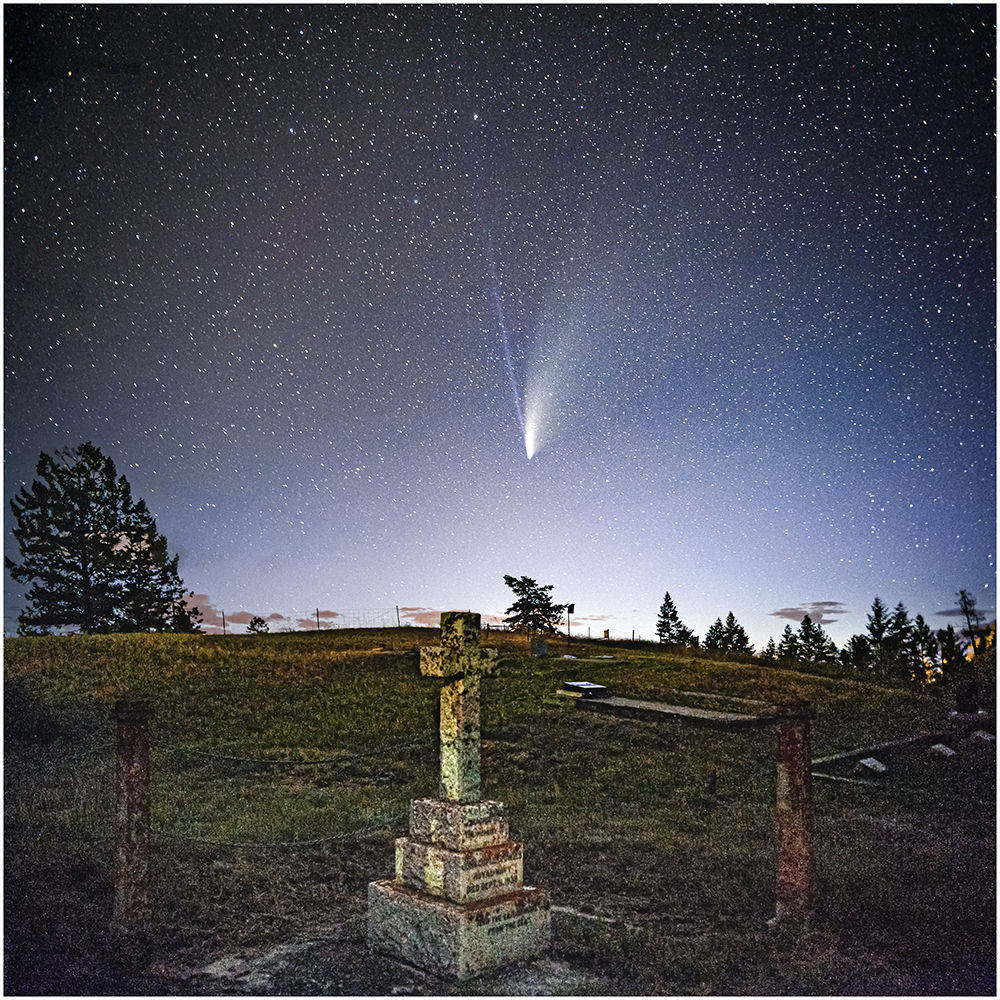
Just a reminder to step outside and try to spot Comet Lemmon, now brightening in northern skies. It may not reach the brilliance of Comet NEOWISE—seen here in 2020—but with comets, you never really know how bright they’ll become.

It’s finally starting to have a chill in the air. I found a home for most of my giant red cabbage. Sophie from Sophie’s Choice Pickles took it to make fermented sauerkraut. Her pickles are incredible and she sells out every year.

***

The good neighbour Larry has been enjoying the carrots. I left a bag of them on his doorstep the other day. I didn’t stay to talk as I was in a hurry and figured he’d find them as soon as he came out the door. They are Chantenay carrots. If you know your carrot varieties you know Chantenay have short thick tapered bodies.

Later that day a friend stopped by who is quite religious. I behave myself in his company. As we talked outside, Larry came out and found the carrots. He grabbed them by the stems and walked to the edge of his property, celebrating the gift raised high, yelled across the road, ‘Thanks for the buttplugs!’

I looked to my pious friend and sheepishly said, ‘They are carrots.’

But I couldn’t resist an answer to my good neighbour as he expects it from me, and yelled back across the road, ‘They are various sizes so you can work your way up!’

He didn’t miss a beat and yelled back, ‘I’m no amateur!’

***

If it clears a little, Willow and I may head out tomorrow morning to look for Comet Lemmon in the coming dawn. Hard to know if it will clear however as some are calling for snow.

Waning Crescent

The moon, Venus and Regulus at 6am shot through a 200mm lens handheld.

A magnificent sight this morning with the waning crescent moon beside Venus and Regulus.

A few things to consider:

The moon is about 385,000 kms away from earth. It takes 29.5 days to orbit earth. Amazingly the same time it takes to complete a rotation or day.

Venus is close to the same size as Earth. It is the second plant from the sun. Earth is the third.

Both the moon and Venus have been observed through history and have important cultural significance to humanity.

Regulus is part of the constellation Leo. It is 79 light years away from us. It is actually four stars in a star system. The largest of the four is four times larger than our sun. It is a dominant star in the night sky.

I could go on with more facts. The point is, we know all of this from observation. I consider this fantastic. Think of the speed, time, math, angles and experimentation needed to prove what we now take as fact. It has been figured out by people like us (smarter than me I concede). Of course, it has taken generations. Something is learned and it gets added to, and so on. It is amazing to me.

It also shows what humanity is capable of when we collectively work together. Of course it takes time.

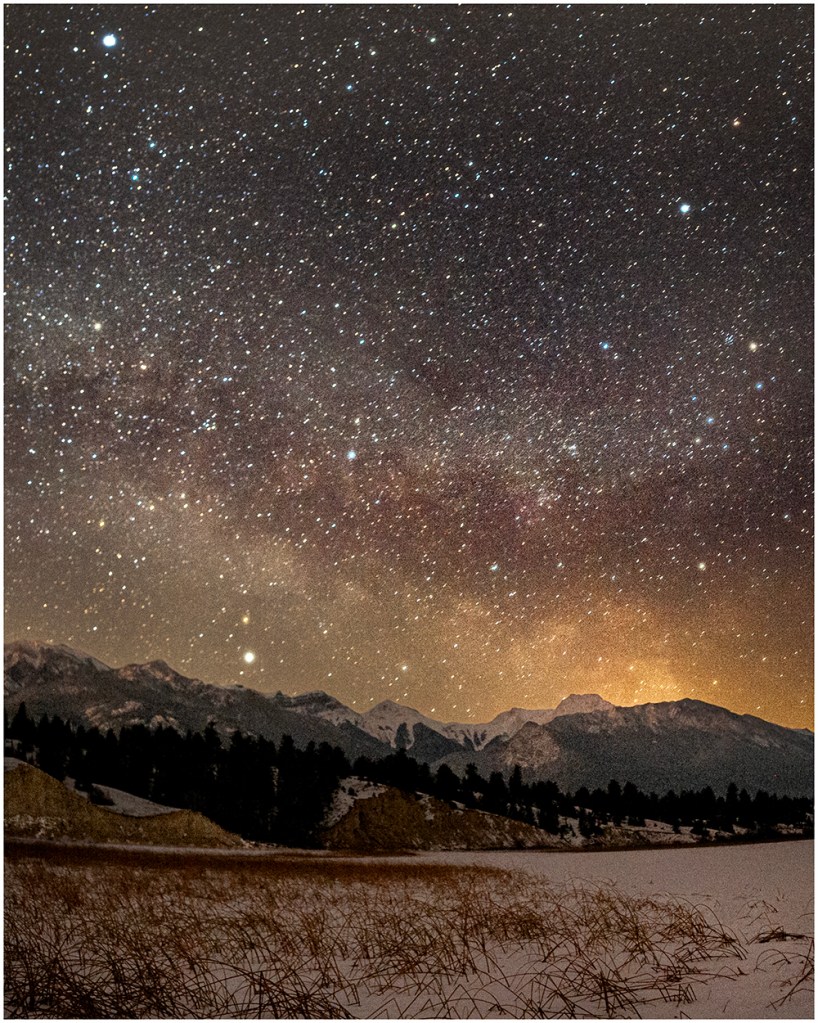
Most of the time on this blog I speak of the spiritual importance of nature. There is something I do in my head; I use the word nature and science interchangeably. I mentioned this to a teacher in high school long ago and was told how wrong I was. I took his word, but didn’t change my mind. I know I don’t understand either. Somehow that gives me peace. The same way watching wild orchids appear shortly after the snow melts or watching The Milky Way reappear, rising sideways in the east, curving above the Rocky Mountain Trench. I get the same feeling considering distance and time working out the trip in light speed to Betelgeuse or The Andromeda Galaxy.

I will leave this earth without contributing to the great pool of knowledge needed for the next great discovery. But shouldn’t the wonderful discoveries we already have be honoured. Shouldn’t that be enough to inspire us to do our best and treat our fellow humans with kindness and respect. It is not a jump from marvelling the brilliance of Regulus to loving your family or even pointing out the moon or sharing a mountaintop to someone interested.

It’s in our nature.

Geomagnetic Storm

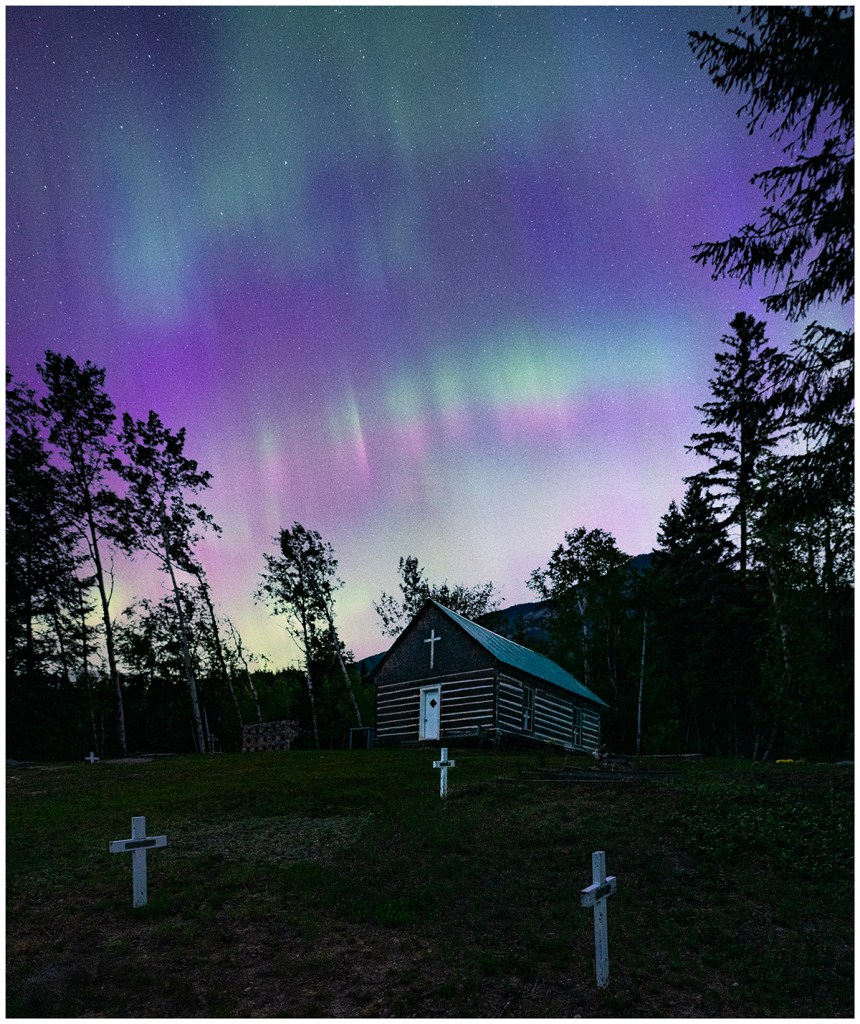
St. Mark.s Church and cemetery near Brisco. One of the oldest buildings in the Valley.

A dazzling display of aurora a few nights ago. Willow and I headed north and stopped on the mile hill overlooking Radium Hot Springs. Knowing they can stop as quick as they start we kept going towards darker skies.

These Northern Lights were caused by activity on the surface of the sun. This coronal mass ejection struck Earth’s magnetic field and lit up the sky. It should have been a dark night, but Willow and I were able to walk around like it was a full moon.

By 3:30 the aurora borealis pulled way back and I could tell dawn was on the horizon. I forget how early morning breaks when the days are long. The longest days don’t even permit a fully dark night.

It was good to get out.

The Mile Hill overlooking the Columbia River and Radium Hot Springs.