A stunning night sky filled with stars over Waterton, showcasing the Milky Way above the illuminated village.
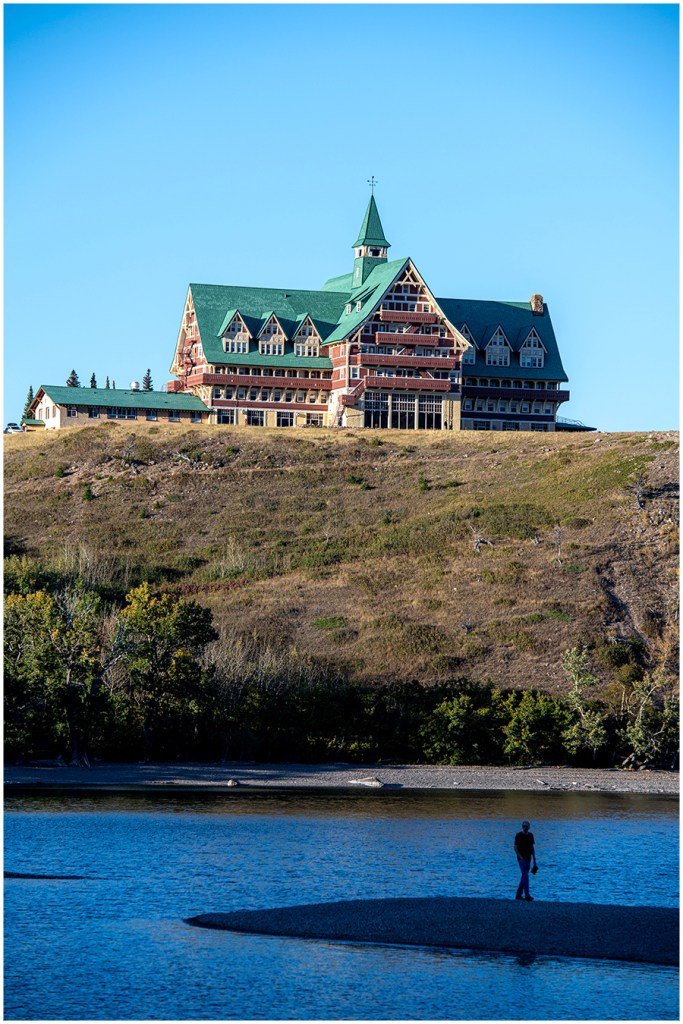
The Prince of Wales Hotel.
Thirty-nine years ago we visited Waterton Park on our honeymoon. The Prince of Wales Hotel looked abandoned. I took a few pictures with the 2.25 Yashica. Once I developed the B/W film all the negatives were blurry from the wind. The negatives were also bad because the film was expired. I didn’t print any of them.
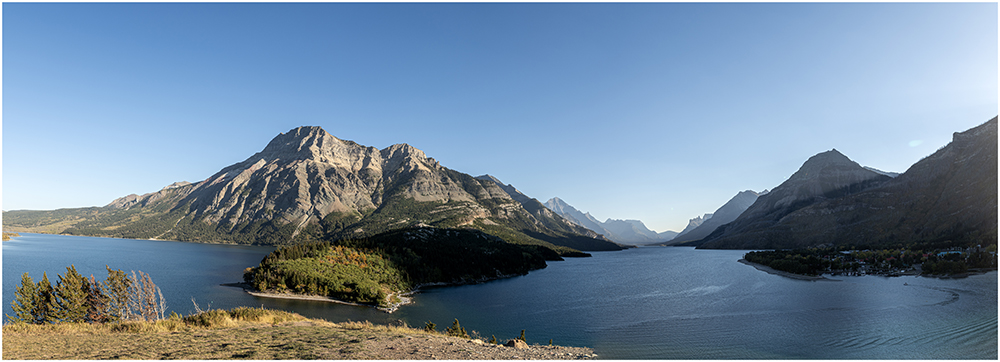
Mt. Vimy between the Lakes of Waterton.
This time the pictures turned out better. The Hotel was a lot more expensive. We even got out under the stars for a wander around.
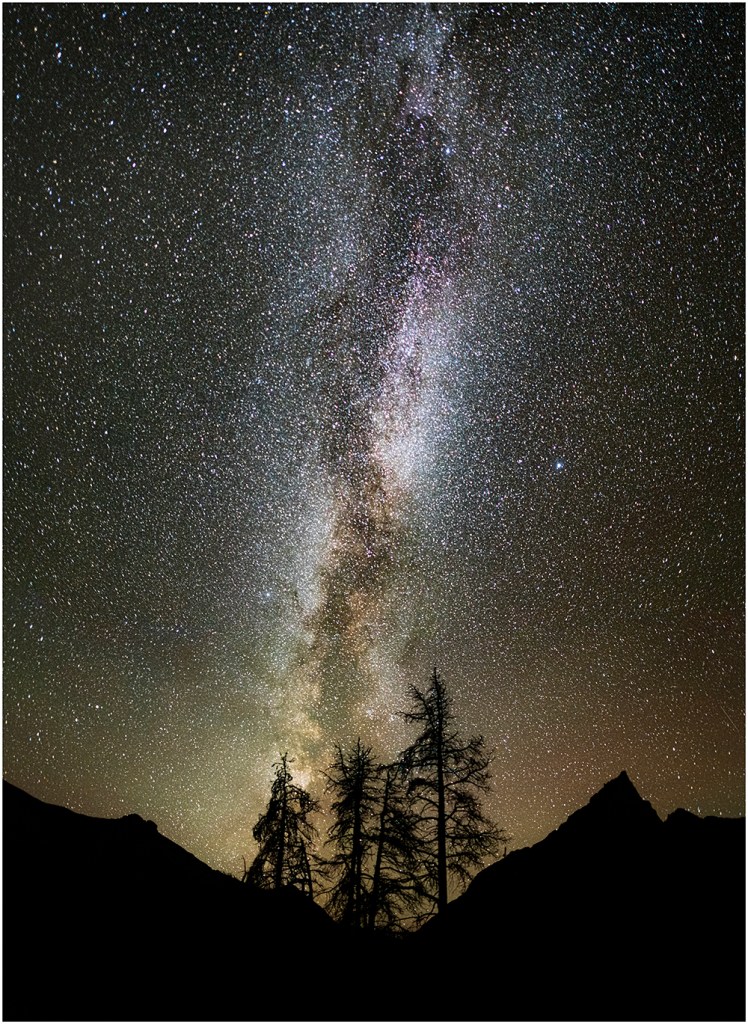
The Milky Way on a backroad away from light pollution. Waterton Park is known for dark skies.
The wind still howls at The Prince of Wales. The skies are dark in Waterton. A piece of The Milky Way is still bright before midnight.
A scenic view of wind turbines standing tall against a clear blue sky. These are prominent at the start of the mountains where the wind blows continually.
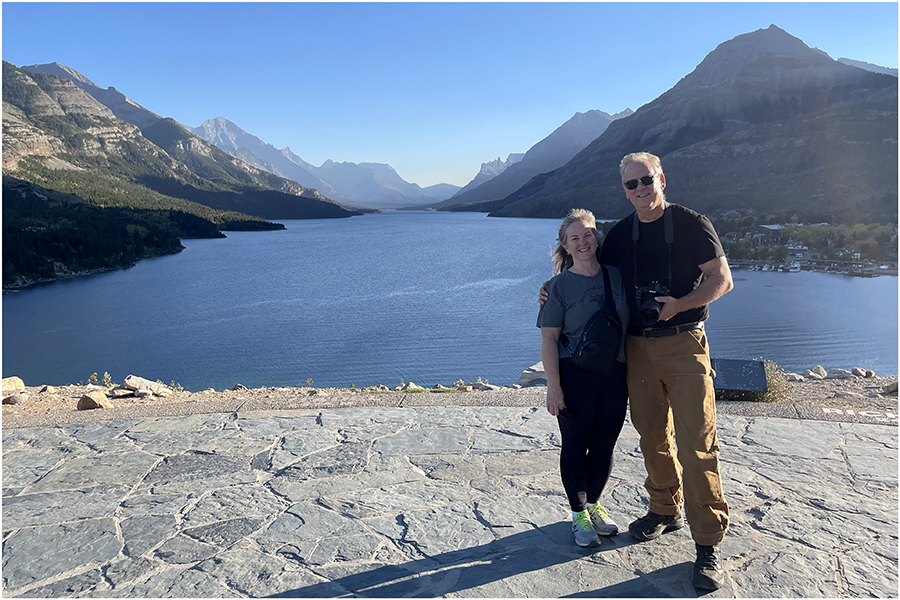
It was nice to get away even for a short time to celebrate our anniversary.
The moon, Venus and Regulus at 6am shot through a 200mm lens handheld.
A magnificent sight this morning with the waning crescent moon beside Venus and Regulus.
A few things to consider:
The moon is about 385,000 kms away from earth. It takes 29.5 days to orbit earth. Amazingly the same time it takes to complete a rotation or day.
Venus is close to the same size as Earth. It is the second plant from the sun. Earth is the third.
Both the moon and Venus have been observed through history and have important cultural significance to humanity.
Regulus is part of the constellation Leo. It is 79 light years away from us. It is actually four stars in a star system. The largest of the four is four times larger than our sun. It is a dominant star in the night sky.
I could go on with more facts. The point is, we know all of this from observation. I consider this fantastic. Think of the speed, time, math, angles and experimentation needed to prove what we now take as fact. It has been figured out by people like us (smarter than me I concede). Of course, it has taken generations. Something is learned and it gets added to, and so on. It is amazing to me.
It also shows what humanity is capable of when we collectively work together. Of course it takes time.
Most of the time on this blog I speak of the spiritual importance of nature. There is something I do in my head; I use the word nature and science interchangeably. I mentioned this to a teacher in high school long ago and was told how wrong I was. I took his word, but didn’t change my mind. I know I don’t understand either. Somehow that gives me peace. The same way watching wild orchids appear shortly after the snow melts or watching The Milky Way reappear, rising sideways in the east, curving above the Rocky Mountain Trench. I get the same feeling considering distance and time working out the trip in light speed to Betelgeuse or The Andromeda Galaxy.
I will leave this earth without contributing to the great pool of knowledge needed for the next great discovery. But shouldn’t the wonderful discoveries we already have be honoured. Shouldn’t that be enough to inspire us to do our best and treat our fellow humans with kindness and respect. It is not a jump from marvelling the brilliance of Regulus to loving your family or even pointing out the moon or sharing a mountaintop to someone interested.
The moon, Venus and Jupiter in Gemini. The faint twins can just be seen to the left and above the moon. Mercury could also be there very low, washed out in the light.
Willow and I headed out early to catch the waning crescent beside bright Venus and Jupiter.
It was my plan to capture them above Chisel Peak but I couldn’t get the angle right with light quickly approaching. The right angle would have required us to walk another mile or so. That would have put the sun near up and me late for work. That’s the way it is sometimes.
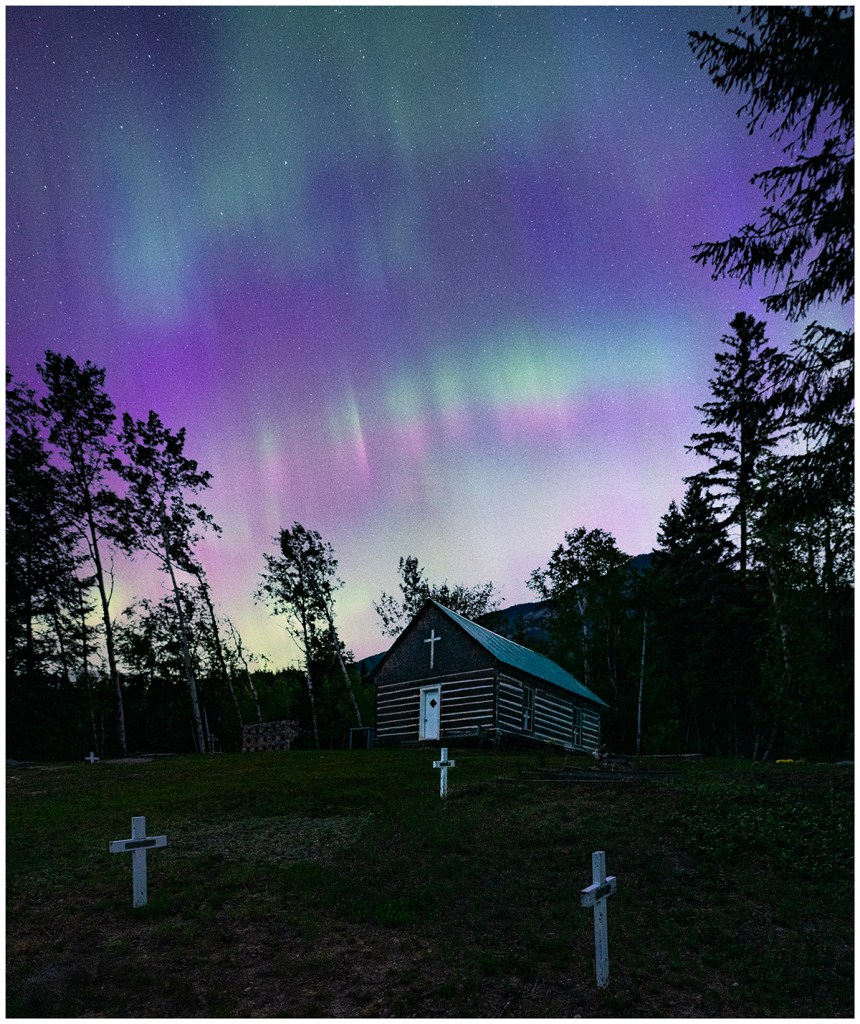
St. Mark.s Church and cemetery near Brisco. One of the oldest buildings in the Valley.
A dazzling display of aurora a few nights ago. Willow and I headed north and stopped on the mile hill overlooking Radium Hot Springs. Knowing they can stop as quick as they start we kept going towards darker skies.
These Northern Lights were caused by activity on the surface of the sun. This coronal mass ejection struck Earth’s magnetic field and lit up the sky. It should have been a dark night, but Willow and I were able to walk around like it was a full moon.
By 3:30 the aurora borealis pulled way back and I could tell dawn was on the horizon. I forget how early morning breaks when the days are long. The longest days don’t even permit a fully dark night.
It was good to get out.
The Mile Hill overlooking the Columbia River and Radium Hot Springs.
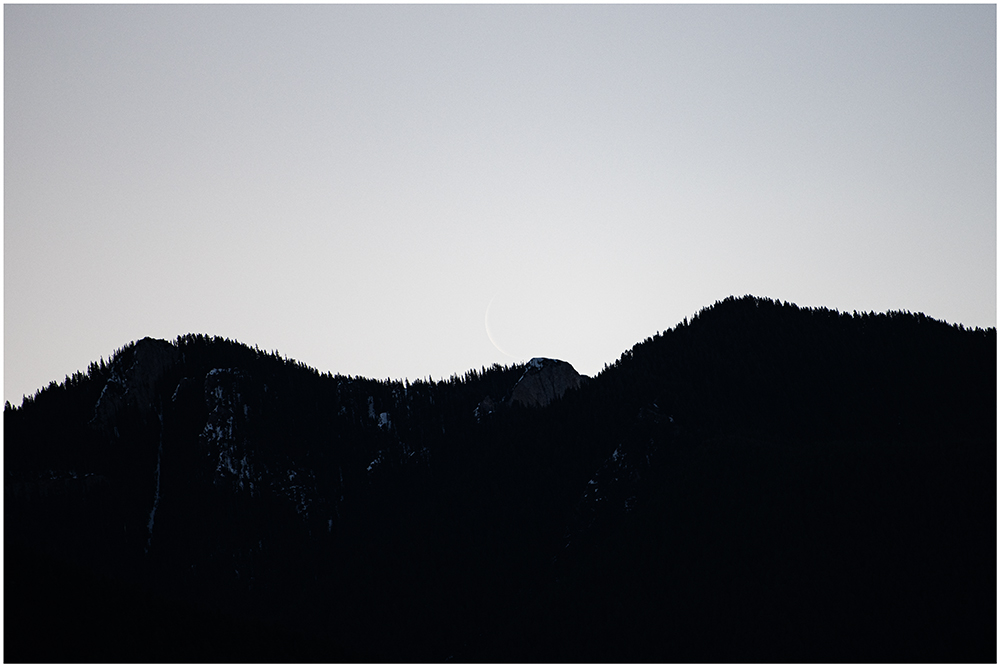
A tight crop of a 200mm frame. The crescent moon is 6% or 7% illuminated.
A crystal clear morning. Venus came up in the morning dawn. The sun caught the top of the peaks in the west before it rose over the mountains. The thin moon rose just before the sun. It was an old waning 6%. Due to its thinness and the morning light it was hard to see. I needed the binoculars to spot it at first. A Robin came and sat close to me and a heard of young Bighorn Sheep ran, about 50 yards in front of me. The way they were going I expected to see something like a coyote or cougar on their heels, but nothing. Something riled them however. The river is still clear and runs slow beside the tracks. Not long now the wetlands will be full. Next moon probably. Very fine morning.
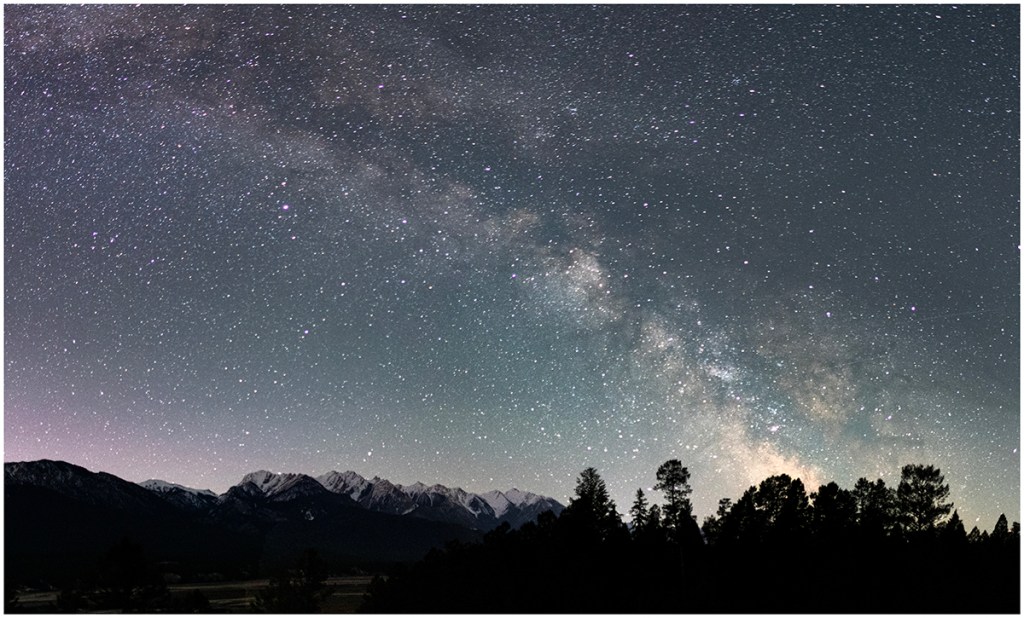
The Milky Way above the Fairmont Range. The Dark Horse Nebula can be seen to the right of the central bulge of the Milky Way.
Willow and I were up early. The moon was due to go down at about 4:30am. Our goal was to catch a bit of the Milky Way before the coming sun started to wash it.
We were off for the end of the lake. The pick-up slid in the mud. It has been clear and warm during the day, but chilly at night. We broke through the ice skimmed over the mud holes, churning this way and that trying to stay out of the ruts.
Just about at our parking spot, damn near level with the lake, I underestimated a strip of mud, letting the truck slide deeper and we were stuck.
There was no going forward or back. We were already in four wheel drive. I shifted the beast into 4 low and it still wouldn’t budge.
I got out and surveyed the situation. It is usually a foot and a half step to the ground out of the truck. This morning the step was just about level with the mud. We were stuck. It was dark. There was only one thing to do. Go looking for the Milky Way.
Willow looked at me sideways as if to say, this is where we are going to park?
We walked up the hills overlooking the lake. Willow stayed close with the coyotes yipping.
The moon was down in the west. The Milky Way stretched east to south. Antares, the heart of Scorpius was well up above the horizon. The Prancing Horse whinnied as if chuckling at our predicament.
We walked to the waters edge. The geese were at it, establishing territory, gearing up for flight. Once it started to get light we headed back to the truck.
I laid some broken branches in a corduroy fashion, shovelled mud and water and did some rocking, lots of rocking. Finally, like a stubborn tooth, the muck let loose and the ship sailed onto solid ground.
The only way out was forward, so I had to turn around and go back through the cranky puddle. Fortunately, I had realized the err of my ways and picked a more favourable route without incident.
Once home it was like Lisa knew I had got stuck. It could have been we were later than usual or the mud soaked up to my knees. She reminded me I wasn’t thirty anymore. I assured her we weren’t stuck, just parked for a while.
Willow and I were first in the mountains then down the lake, on the west side, anticipating the return of the galactic centre. Willow barked at the coyotes yipping. An owl started up somewhere behind us, then was quiet, maybe busy filling it’s belly with an unlucky vole.
The Milky Way curved from north to south. The stinger of Scorpius glowed red, a smear of greenish northern lights, turning magenta over the Giant Chief Nutmuq¢in.
An imagined glacier under foot. Even Willow bought into my tall tail, and gave me the cautious look of, let’s not fall through. You worry to much old hound, just the same, there is coffee an’ a muffin waiting. Plus we had our proof, spring is really on its way.
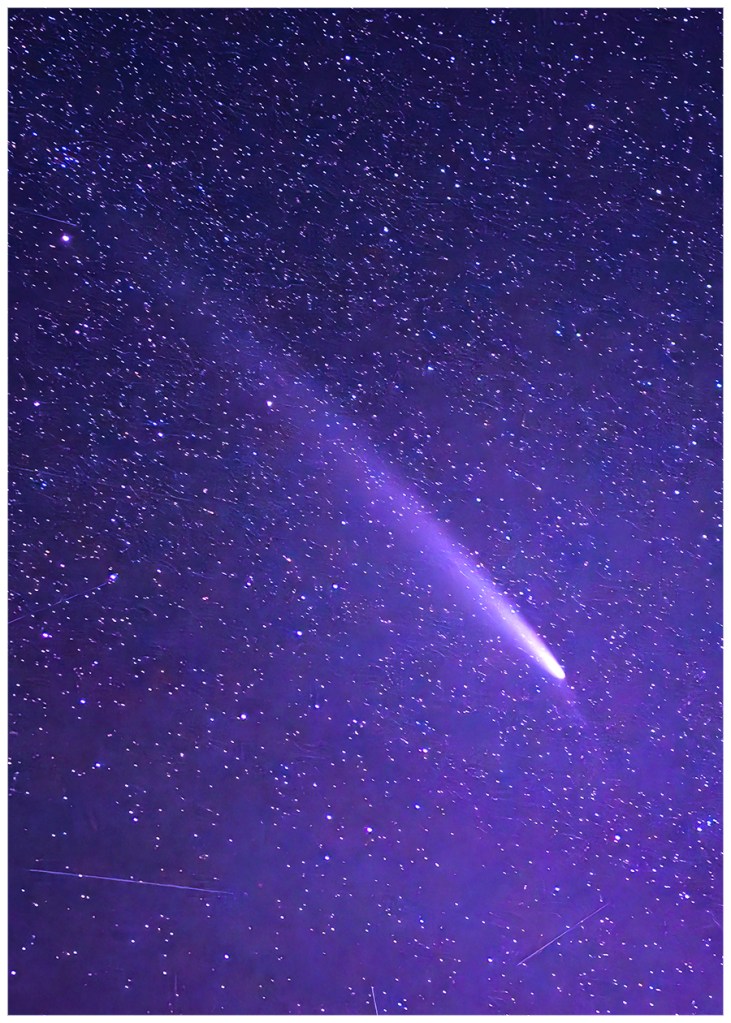
This is a closeup of the comet from a couple of nights ago. It is not taken with a telephoto lens. That would require a piece of equipment that tracks the sky which I don’t have. Instead it is taken with a 55mm lens and cropped tight.
Amazingly, 10 satellites can be seen in this photo of a small piece of the sky. You may not be able to see them depending on what computer or phone you are reading this post.
Most of the satellites are Space X communication satellites. It is amazing how many more there are than only a few years ago.There is something about them, that I can’t put my finger on that makes me uneasy. When I see so many it makes me think the world is going down the shitter. I don’t know why I have this feeling.
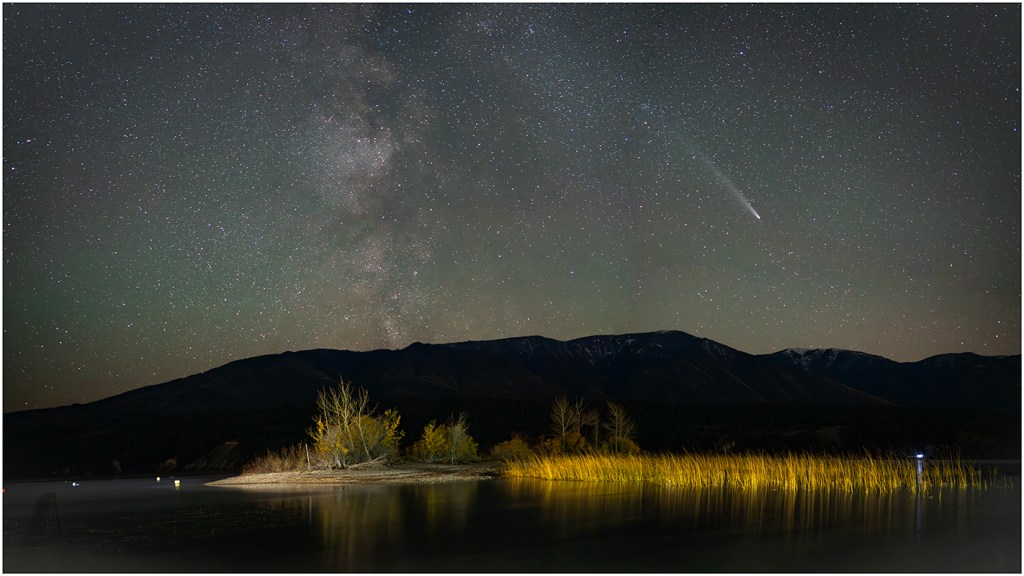
Comet Tsuchinshan-ATLAS is seen to the right of The Milky Way.
Stayed up past bedtime for another crack at seeing Comet Tsuchinshan-ATLAS. It was more difficult to pick out, but with a little squinting I found it in a much higher position than the last time we spotted it. Without dark clear skies it would have been impossible to see.
The comet is racing away from us, back to the Oort Cloud, and getting dimmer and smaller by the day.
I took quite a few photos on different camera settings. Once I go through them I will share more here. The photo above is a panorama of six shots stitched in Adobe Lightroom. It was taken on a much higher ISO than I usually use for astrophotography, but was necessary with the lens I was using. Well worth losing some sleep over.
The tail of Comet Tsuchinshan-ATLAS extends above the cloud cover.
We have been battling the clouds but was able to get one picture of the comet tonight. It is not the greatest picture due to having my camera set wrong. It does show its long spectacular tail.
Comet Tsuchinshan-ATLAS is rising in the sky, providing we get some clear skies there should be more opportunities to see it.
It will be very interesting to see how it interacts with the waxing moon.









 Palliser Pass