Photo Project

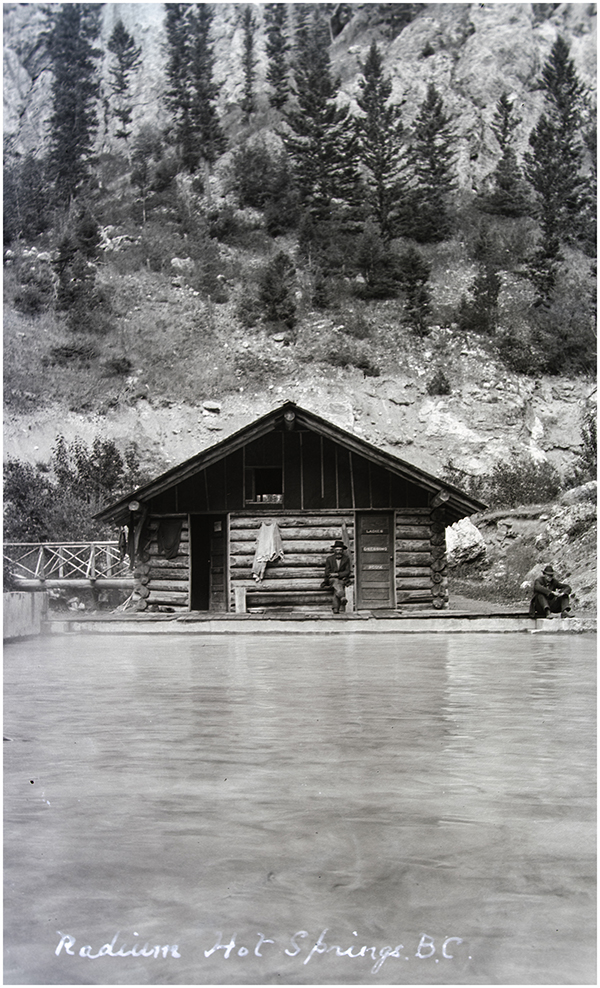
Radium Hot Springs Pool, Circa 1920, A.E. Fisher.

I have started on a project I have been wanting to do for some time. My parents left me a large collection of historical photographs, most dating from the 1920s and 1930s. All of the images exist only as negatives, with no printed positives, which makes it difficult to assess their quality or even know exactly what they depict. Until they are digitized, much of the collection remains effectively hidden.

The photographs are from various photographers, but many are attributed to A.E. Fisher, one of the first photographers in the area. The negatives measure 3.25 by 5.5 inches and contain exceptional detail. Many are beautiful images of the region and its people from a time before the area was widely populated. Included in the collection are approximately 110 negatives of First Nation people.

I have worked with these First Nation negatives in the past to ensure the Ktunaxa Nation received digital copies for their archives. Many of these images are both striking and historically important, documenting a period for which relatively few photographs exist.
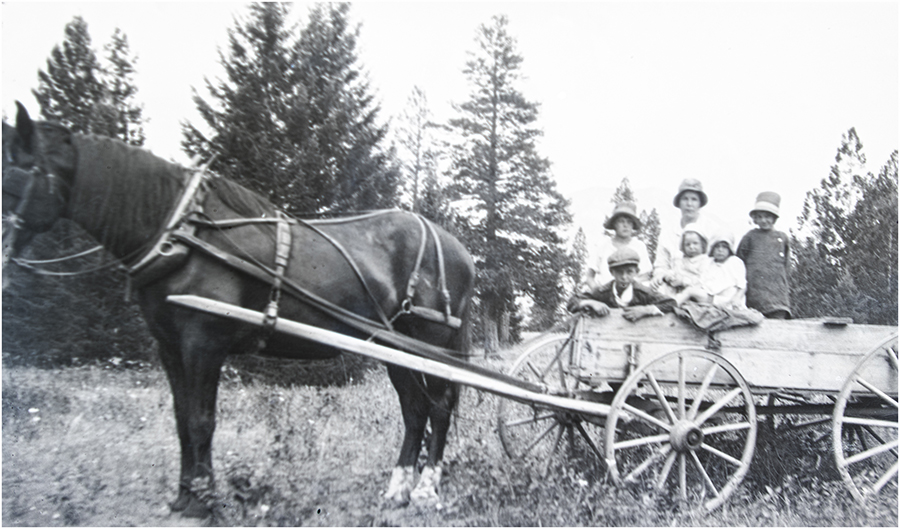
Family outing, A.E. Fisher.

One of the main reasons I put this project off for so long was the amount of time required to digitize the collection. Using a flatbed scanner, each transparency scan takes a significant amount of time, followed by additional processing of the digital file. To speed things up, I developed a more efficient workflow by photographing each negative on a light box using a digital camera. The files are then cropped and reversed into positives in Photoshop, where I also make minor corrections. The images are then downsized and imported into Lightroom, which provides robust library and archiving tools. At this stage, descriptions and keywords are added to make the images easily searchable.

The resulting files are not necessarily intended for high-end printing—although decent prints could certainly be made—but rather to create a practical, accessible archive for future use. Once digitized, the original negatives are filed and labeled with corresponding file names. If a high quality large print was needed the original negative could be accessed and scanned.

Each negative now has an associated digital file that can be searched on a computer and includes information such as photographer, location, and subject matter. This allows the images to be used for research, storytelling, and printing while protecting the original negatives from further handling and deterioration.

It is a large and time-consuming project, but a worthwhile one. Already, I have uncovered photographs that are both fascinating and historically significant—images that may otherwise have remained unseen.
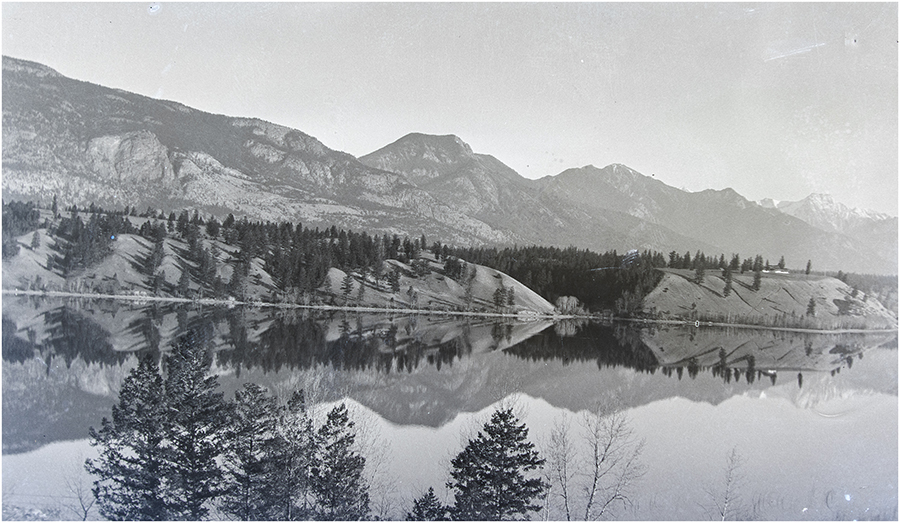
Lake Windermere, Circa 1920, A.E. Fisher.
This shows the east side of Lake Windermere before development.

and now for something completely different

This is a composite made from a photo my son Hunter took in downtown Calgary, and a picture I took of the Milky Way.

There is a photographer who used to do cityscapes with stars in the background. They were compositions when they weren’t easy to do with the software available at the time. He tried to show what cities would look like without light pollution. They were eerie. His name is Thierry Cohen if you want to check him out.

Many, if not most, of the astrophotography photos seen now are composites in one way or the other. Often the landscape is taken in one shot and the sky is taken in another. The time and place of the two or more photos can vary greatly. Like this composite for example.

The problem is composites are often presented as real. There is a photo of a nearby historic town with a well known mountain. Above the mountain the Milky Way shoots straight up in the east. The problem is the Milky Way is never in that position. It is a two photo composite. The photographer never presents it as such. The photo has been on magazine covers and sold as fine art photographs. It is probably one of the most well known photographs of that area. Yet the scene it depicts doesn’t exist. Does that matter as we enter an era of AI produced images? Where it is becoming impossible to tell the difference between what is real?

I have always appreciated documentary style photography. It is what I try to do on this site. It is to show change and also provide a record. That attitude probably comes from my family’s history in newspapers.

With this said, I like Hunter and my collaboration. It is not representative of reality, it is more symbolic. What would a city look like if the lights were off on a clear night? Would the world be a different place if we all could see the stars?

Hunter enjoys mixing music. Like his mixes, like art, like this photo, it is essentially storytelling and exists to make us think.

Jimmy

Jim Galligan is a coworker of mine. He is very dedicated to his job and can be depended on to lend a hand when asked. He is one of the longest serving employees at the resort. He is respected and well liked by management, staff and guests.

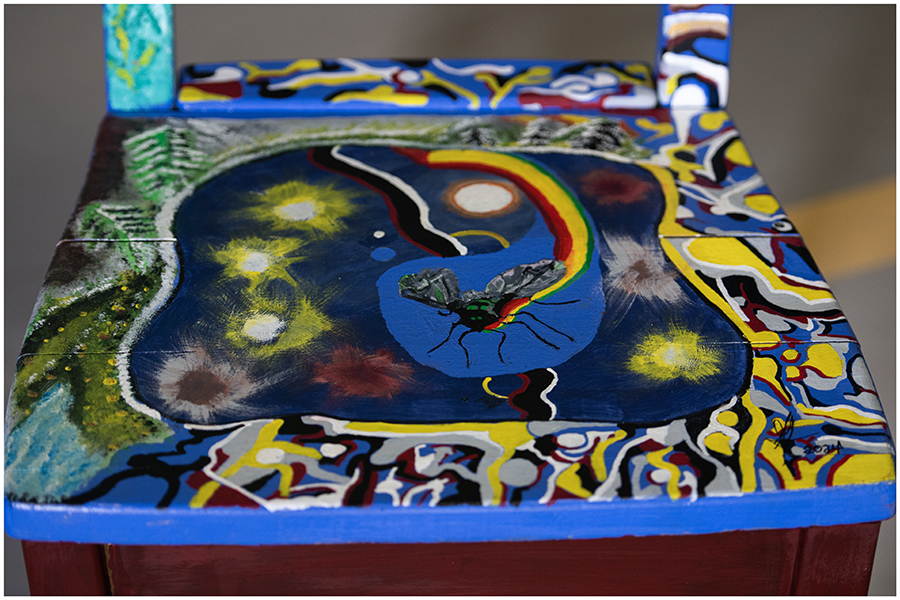
Lately, in his spare time, he has been creating art. He paints old furniture and clock faces and makes them into one-of-a-kind folk art pieces.

His work is bright and whimsical with shapes and subjects found in nature. To look at them is to see an extraordinary mind at work, and how Jim sees the world.

Jim is a rare soul whose good nature exudes optimism and humour. His artwork displays the same qualities. They can’t help but make you smile.

Jim’s earlier work has been collected and, I am sure, his new art will find its way to loving homes.

Art Show

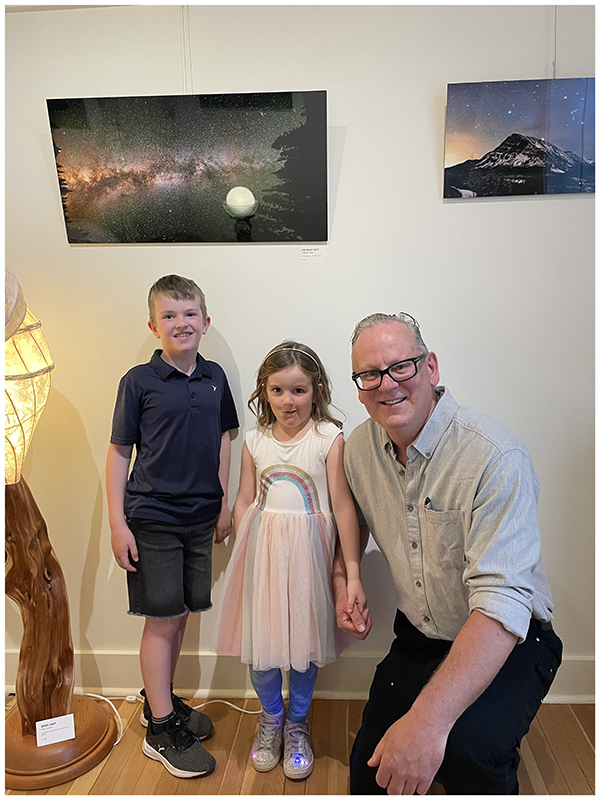
Cooper, Scarlett and me on opening night.

The art show I was included in at CV Arts is now over. I went down and picked up my prints. Lisa and I had many kind comments about the pictures we chose to be part of the exhibit.

I want to thank everyone who stopped by, especially all of my family and friends who came to the opening. I am very uncomfortable in group settings and they made it bearable. Special thanks to Deb, Kurt and Brian for providing the wonderful music. Also thanks to CV Arts for allowing me to show.

Having never taken part in an exhibit like this it proved to be a learning experience. None of the photos sold, which was disappointing to me and also the managers of CV Arts. I would have liked to see them get some of their money back for hosting the exhibit.

The photos Lisa and I picked were closer to ‘fine art’ then most photos I take. We thought they would fit what CV Arts was looking for. The truth is I am not much a fan of fine art photography nor do I think I do it well. My composition is usually off and my processing and printing leaves much to be desired.

I prefer documentary style photography. There are many documentary photographers I admire. My Mother Isabelle was a fine documentary photographer. Most of the photos I produce are in this style. It may be the return of The Milky Way in February, a meteor shower or a conjunction of planets that is the subject and time I am trying to capture. They are often poorly processed and composed.

One of my favourite photos I included in the exhibit was of The Sacred Heat Church that is located on the Akisqnuk First Nation Reserve. The church is dilapidated. The door is open a crack and there is a set of footprints leading up the stairs in the snow.The sky is blue signifying morning. A telephone pole, crooked (bad composition) with a wire connected to the church with The Milky Way in the background. This photo is a testament of the role the Catholic Church has played in First Nation communities and an example of document photography. It is not fine art, nor would any one want to hang it in their house or cabin as a reminder of the atrocities the church has played in Canada and indigenous people.

I would like to say the show was a success, and in a way it was, my kids and grandkids got to see me in a different light. However, it was expensive and opening night was nerve racking. Will I exhibit in such a manner again; probably not.

It would be nice to make some money from photography, but it is far down the list of why I enjoy it. It is the getting out, seeing the stars, flowers or mountains and bringing a little piece home. Often I see something I hadn’t noticed when I clicked the shutter.

When my father lay dying I would bring him small pieces of the forest, a rock or a huckleberry blossom, something to remind him where his soul yearned to be, beyond his bed and walls, in the place he loved so much.

Nowadays, I do it with photos, but they are for me, my family, a few friends and anybody else who sees it that way. After all we are all going to get there sometime and need reminding.

It sounds lofty, but it isn’t, self gratifying; absolutely – it ain’t art, it’s a document.