Heartbreak

Yesterday was tough, hearing the news of the school shooting from Tumbler Ridge. In the coming days, there will be plenty of comments on why it happened. Most will not be helpful.

It is tough to comprehend the feelings the people of the small town must be experiencing. The whole of Canada is in mourning for the families touched by this tragedy.

When I was young, I feared many things. Somehow, though, I believed I had a measure of control over those fears. I could outrun them, outthink them, or at least convince myself they were manageable.

I wonder what children think now, growing up in a world where news travels instantly to the palm of their hand. A phone can feed fear twenty-four hours a day. At certain ages, it is easy to focus only on the darkness and not yet understand that life bends back toward light. I suspect many young people feel powerless—not just over the world, but sometimes over their own thoughts and emotions.

If my grandchildren ask about this tragedy, what will I say? How do you promise safety in a world that offers no guarantees?

Lisa and I have tried to make our house a safe place for our grandkids—a place where they know they are loved unconditionally. We try to show them beauty in small things. They help me in the woodpile and the garden. Lisa shows them how to bake and keeps a huge supply of art supplies for any project. We have supper together at least two times a week, where we talk about our day. We want them to feel safe and to feel they have some control, maybe not over the threats of the world, but over how they approach them. All we can do is love them.

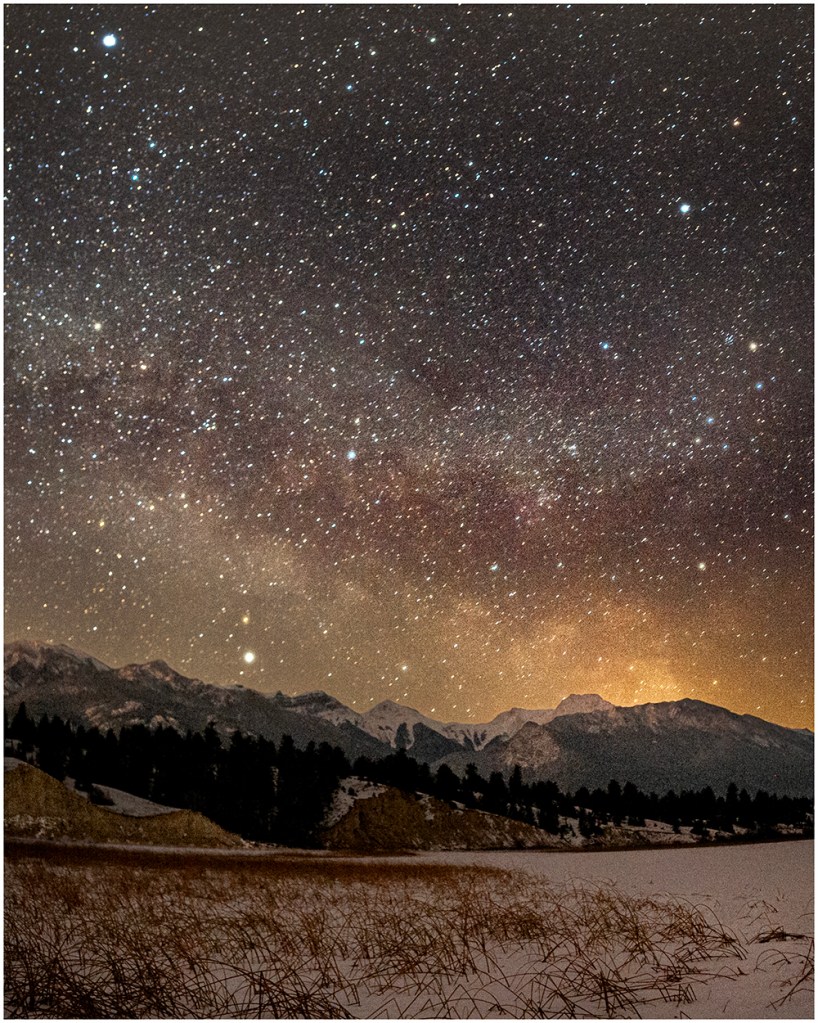
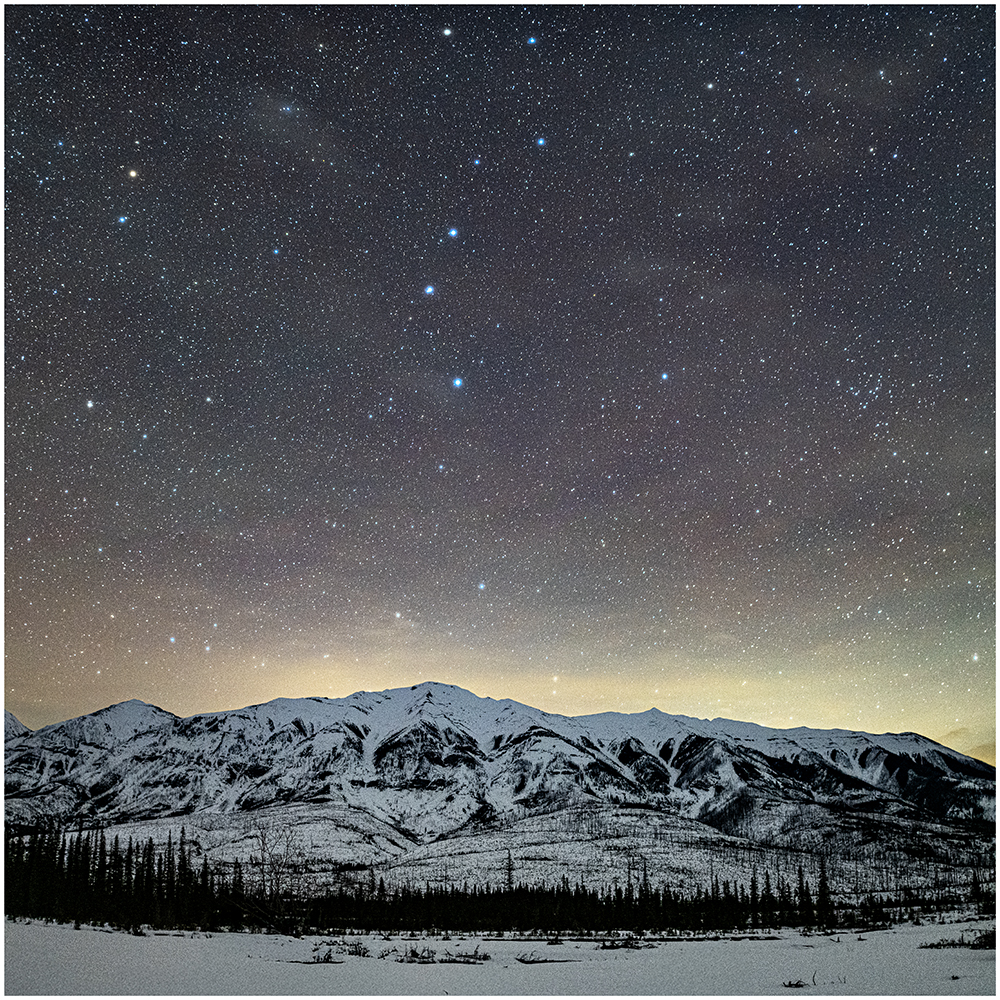
Last night, I went looking for stars and peace. It was after midnight but before the moon was up. I could hear the creek flowing under the ice. The mountains were in outline, and the familiar constellations were holding their own.

My mind eased if only momentarily. I stopped before the creek to make sure I didn’t break through the ice in the dark. There may never be true safety. You can only take it all in and know that good will offer a path. It may never be safe all the time, but the more often you look for good, the more often you will find it. Unfortunately there is no consolation for the people of Tumbler Ridge and the families suffering with heart breaking loss.
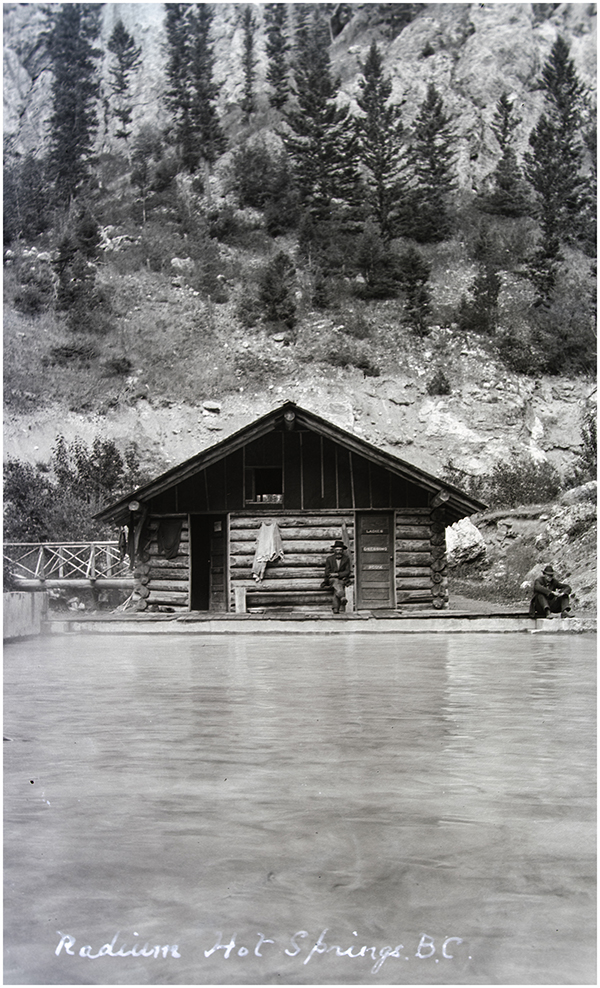
Photo Project

Radium Hot Springs Pool, Circa 1920, A.E. Fisher.

I have started on a project I have been wanting to do for some time. My parents left me a large collection of historical photographs, most dating from the 1920s and 1930s. All of the images exist only as negatives, with no printed positives, which makes it difficult to assess their quality or even know exactly what they depict. Until they are digitized, much of the collection remains effectively hidden.

The photographs are from various photographers, but many are attributed to A.E. Fisher, one of the first photographers in the area. The negatives measure 3.25 by 5.5 inches and contain exceptional detail. Many are beautiful images of the region and its people from a time before the area was widely populated. Included in the collection are approximately 110 negatives of First Nation people.

I have worked with these First Nation negatives in the past to ensure the Ktunaxa Nation received digital copies for their archives. Many of these images are both striking and historically important, documenting a period for which relatively few photographs exist.

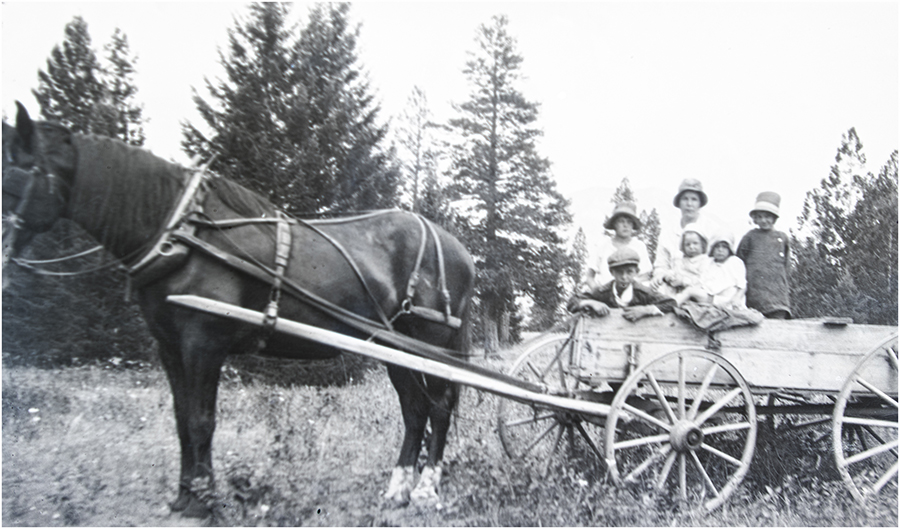
Family outing, A.E. Fisher.

One of the main reasons I put this project off for so long was the amount of time required to digitize the collection. Using a flatbed scanner, each transparency scan takes a significant amount of time, followed by additional processing of the digital file. To speed things up, I developed a more efficient workflow by photographing each negative on a light box using a digital camera. The files are then cropped and reversed into positives in Photoshop, where I also make minor corrections. The images are then downsized and imported into Lightroom, which provides robust library and archiving tools. At this stage, descriptions and keywords are added to make the images easily searchable.

The resulting files are not necessarily intended for high-end printing—although decent prints could certainly be made—but rather to create a practical, accessible archive for future use. Once digitized, the original negatives are filed and labeled with corresponding file names. If a high quality large print was needed the original negative could be accessed and scanned.

Each negative now has an associated digital file that can be searched on a computer and includes information such as photographer, location, and subject matter. This allows the images to be used for research, storytelling, and printing while protecting the original negatives from further handling and deterioration.

It is a large and time-consuming project, but a worthwhile one. Already, I have uncovered photographs that are both fascinating and historically significant—images that may otherwise have remained unseen.

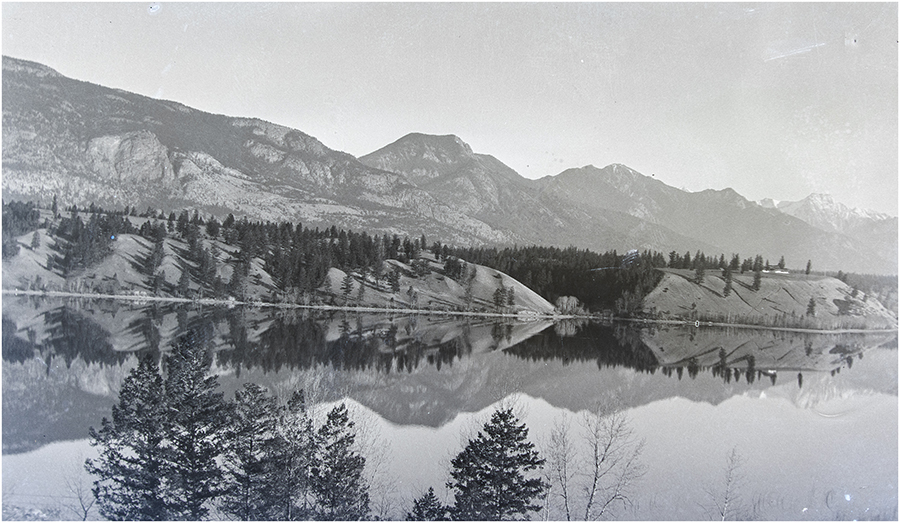
Lake Windermere, Circa 1920, A.E. Fisher.
This shows the east side of Lake Windermere before development.

Winding Down

Finally a good layer of ice on the lake. Providing there is no snow tonight, Cooper and I will be heading down for a skate. We will have a few pucks to toss back and forth. We might even take the net. You learn fast if you miss it you have to skate a long ways to retrieve the puck.

It’s good to feel the cooler temps.

White Christmas

Merry Christmas from Palliser Pass at the head of the Columbia River in British Columbia, Canada.

Ice-Out on Lake Windermere

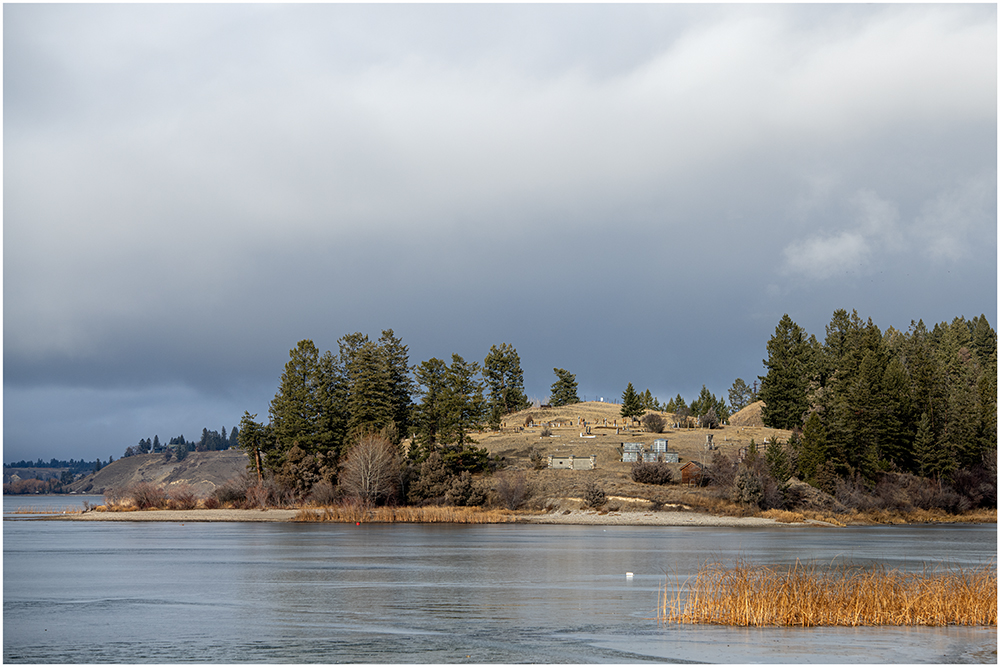
Only a thin layer of ice remains on the south end of Lake Windermere. Looking close you can see the ice breaking up. The ice is about midway in the lakes 12 mile length.

Incredibly mild weather for December. +6°c, rain and a stiff south wind. The ice on about half of Lake Windermere has gone out. In the sixty, some odd, years I have been observing the lake I cannot remember it doing so in December.

The ice was late forming this winter with only a thin skim by the end of November. I am usually skating on the lake by the end of November. This year I went for a swim instead.

Standing at the north end of the Lake near dark. The ice in the foreground has been blown to the shore.

In the early 2000’s, when I was with the newspaper, I can remember writing an editorial mid December to be careful on the lake ice as it could be unsafe. It had been mild that year. The point of the article was to warn tourists and second home owners to be mindful as they may have been used to driving on it in December. The way it looks this year the tourists and vacation home owners could be putting their jet boats back in for the Christmas holidays.

The lake in winter has always been a special place for me. Skating, skiing, driving and fishing. There is nothing like being out there in the cold and quiet. Whenever I have had to endure pain I’ve always thought of the lake and the silent white surroundings while standing in the middle to get me through. It is what I imagine heaven to look like. It truly is a remarkable place.

We are expecting more warm weather. If so I can only guess the rest of the ice will break up and flow down the Columbia.

If my old friend Ray was still alive, he passed a few years ago at 103, I’d ask him if he’d ever seen this before. I would bet he would say no and be equally surprised. As I’m sure my Dad would have been. Christ, I’m an old-timer now and I’ve never seen Lake Windermere open in December.

A Cold Warm

Winter tree.

Rain in the valley bottom. I was sure the lake was going to go back out. It hung in there but the ice is thin.

Lisa and I headed into the mountains yesterday. when we started heading up the rain turned to snow and covered the trees and turned it into a winter wonderland. Willow chased snowballs and looked a little like a snowball herself.

Today I went back up and the snow had turned back to rain. The snow covered trees had shed their layer of white. It was foggy as temperatures adjusted. It has been a very mild winter so far.

Bohemian Waxwing.

We headed for the lake and ran into a flock of waxwings looking happy. Somewhere along the way Willow decided to roll in what I believe was goose shit. The warm weather has revealed smells for her to discover.

Back when I was a kid if our dog rolled in something they weren’t allowed in the house. They had to stay outside day and night until they were deemed fit to come back inside. I mentioned this to Lisa but she didn’t think this would be fair to Willow. Instead she said I should give her a bath and told me Willow’s shampoo is in the left drawer of the bathroom cabinet.

The Ol’ Boneyard.

The bathroom cabinet is under the sink. It has 2 drawers and 3 cupboards. I realized then, as it had never occurred to me, Willow and I share one small drawer in the bathroom. Shampoo, tick repellant, cider vinegar for skunk smell and a couple razors. The rest of the cabinet is for Lisa’s stuff. I mentioned this to her and she said, you two are low maintenance.

It’s bound to get cold sometime. I wish it would hurry up. This mild wet weather always makes a body feel cold. A warm cold.

On Thin Ice

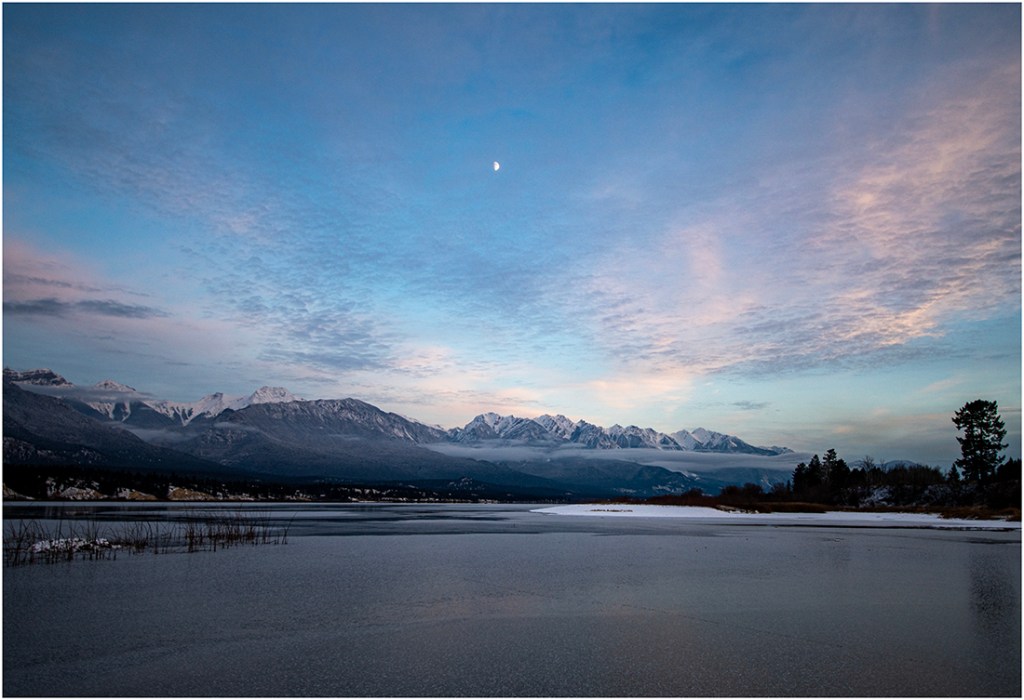
Fresh ice under a waxing gibbous November moon.

A thin layer of ice formed on Lake Windermere in the last couple days of November. Very late compared to years past. Since I usually skate on the lake in November, and wasn’t able to due to the thin ice, I took the opportunity to get in a final swim. More of a dunk actually.

I creeped out on the ice until it cracked and I went through. I had an axe with me to chop my way to shore if needed. Willow wasn’t happy with my choices. Even she knows thin ice can’t be trusted. Lisa took the photo and told me explicitly beforehand not to expect her to save me.

***

The good neighbour was having vehicle trouble and broke down a few miles from home. He asked if I’d give him a ride and help him get it going.

A little tinkering and we got it going. It sounded like shit. Which isn’t totally unusual as the good neighbour has always driven beaters. He usually got them through a trade of one sort or another. At one time he would drive them until they died and then leave them in his yard. I guess his thought was he may get them going again. Then he would start filling them up with other stuff that wasn’t working, but he might get going again. Kitchen appliances, screen printing equipment, even big stuff that made you wonder how he got it too fit. He had a 60 inch TV in one of them. He called them his treasures and reminded me he’s never had a car payment.

Once we had his car going and we let it idle for a while I followed him home to make sure it didn’t break down again.

He says he has some travelling to do over Christmas so he is going to have someone look over the vehicle.

A few days later he texted me and said Grant took a look at it and it still starts. Grant is one of his drinking buddies and is a retired grocer. I, as well, have drank with Grant and if there is something I know it’s that he is not mechanically inclined.

I texted back, ‘You had Grant the grocer diagnose your vehicle? Most people in the same situation employ a mechanic.’

He texted back, ‘That’s a little harsh. If I only had your looks.’

There you have it. The good neighbours vehicle has been given a clean bill of health by Grant the grocer and he is set to take it on his Christmas tour all over British Columbia in the dead of winter.

As long as it rolls out of his driveway he is good to go.

Carrot Girl

As most folks in the valley know, the Birchman has been wandering these woods for ages. He’s the quiet sentinel who startles anyone foolish enough to scar the land. Legend claims he rose from the ashes of a colossal forest fire, and let’s just say—you don’t want to end up on his bad side.

Cooper and The Birchman.

This year, though, a new hero sprouted onto the scene: Kaleman. Kale is a super-green, and Kaleman is—naturally—a super man powered by it, devoted to making sure everyone gets their daily dose of vegetables.

Kaleman.

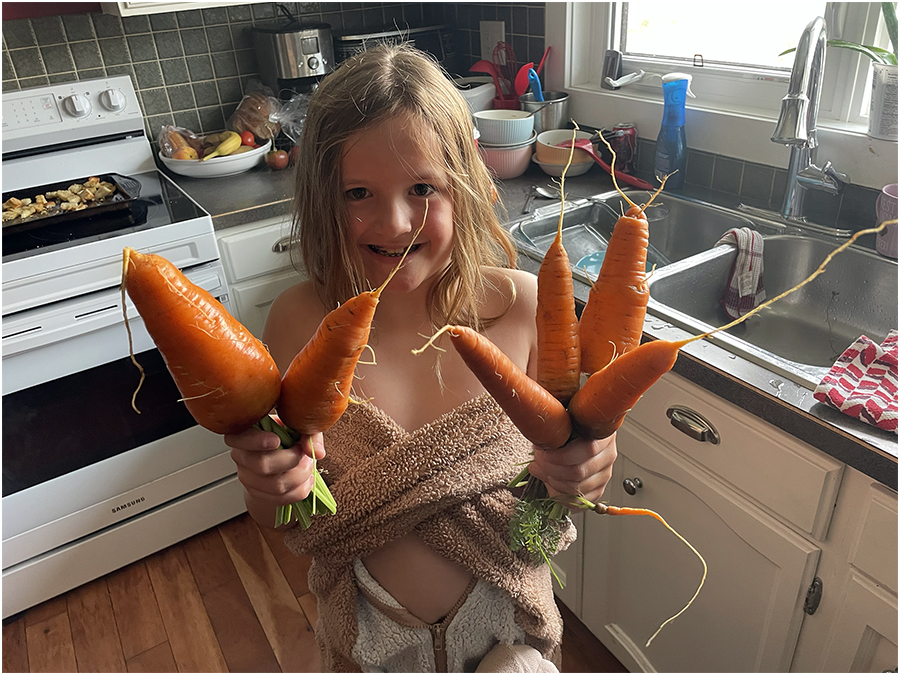
My granddaughter Scarlett knows these characters well. She also happens to be the unrivaled champion of spotting the biggest, sweetest carrots in the garden.

At some point she decided the Birchman and Kaleman might need backup. And so, Carrot Girl was born. She’s bold, unafraid of a little dirt, and blessed with extraordinary eyesight—useful, since Birchman and Kaleman’s vision seems to fade a little more each day.

Carrot Girl!

Scarlett used an AI program to create the movie poster above, which is rather delightful. After a few experiments and nips and tucks, she looked at it proudly and announced, “Now this is a movie I’d watch!”

Remembrance

A few months ago, my sister Deb was contacted by a teacher in Liphook, England, seeking information about our grandfather and father, both of whom were born there. The teacher’s class is researching soldiers from Liphook who immigrated to Canada and served in the First and Second World Wars.

What a treat to hear back from the teacher with a write up about the research and the presentation given to the Royal Highness the Princess Royal.

***

Dapper

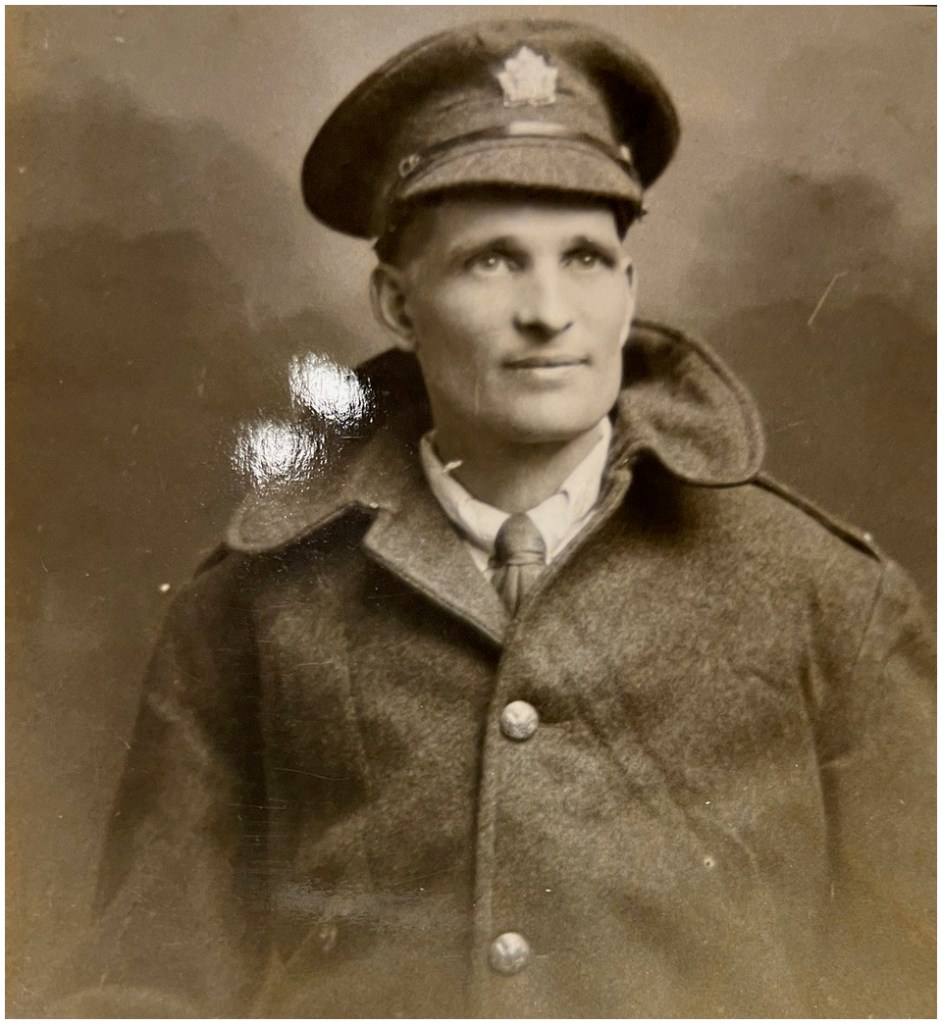
Ernest (Dapper) Ede came to Canada in 1912. He enlisted with the Canadian Army’s Fifty-Fourth Battalion in World War One and was wounded in Passchendaele. This landed him an extended time in hospital in England. During this time he married a nurse named Winnifred, our grandmother. They returned to Canada in 1923 to homestead in Windermere, British Columbia. Dapper died in 1972.

Ron

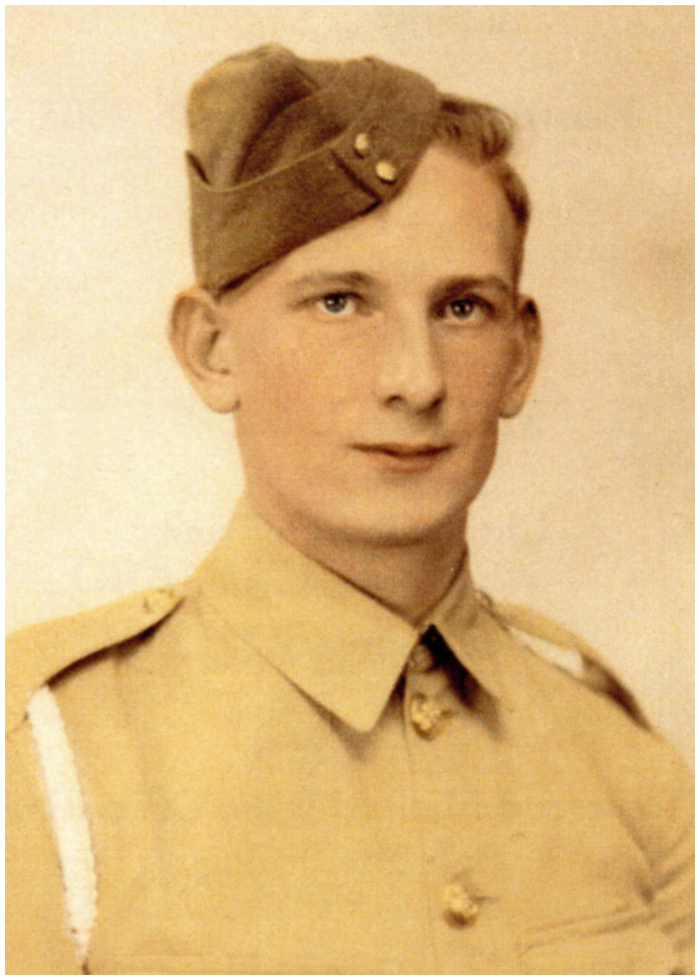
Ronald Ede was born in England in 1923 and arrived in Canada a few months later. At 17 he enlisted, becoming a member of the elite First Special Service Corps – the Devil’s Brigade. During World War Two he met Isabelle and they were married shortly there after and before being shipped overseas. After the war Ronald became a Linotype operator and worked for The Hamilton Spector and The Calgary Herald before returning to Windermere to manage and eventually own, along with Isabelle, The Lake Windermere Valley Echo. Dad died in Invermere in 2003.

***

Dapper and Ron would have been so proud to have been included in the presentation given by the students of Liphook C.of.E Junior School. Our heartfelt thanks to teacher Jenny Brown for such a special gift of Remembrance.

This is the link to the article that also includes photos and a video.

https://www.portsmouth.anglican.org/news/2025/06/25/royal-presence-pupils-pay-canada-day-tribute/

and now for something completely different

This is a composite made from a photo my son Hunter took in downtown Calgary, and a picture I took of the Milky Way.

There is a photographer who used to do cityscapes with stars in the background. They were compositions when they weren’t easy to do with the software available at the time. He tried to show what cities would look like without light pollution. They were eerie. His name is Thierry Cohen if you want to check him out.

Many, if not most, of the astrophotography photos seen now are composites in one way or the other. Often the landscape is taken in one shot and the sky is taken in another. The time and place of the two or more photos can vary greatly. Like this composite for example.

The problem is composites are often presented as real. There is a photo of a nearby historic town with a well known mountain. Above the mountain the Milky Way shoots straight up in the east. The problem is the Milky Way is never in that position. It is a two photo composite. The photographer never presents it as such. The photo has been on magazine covers and sold as fine art photographs. It is probably one of the most well known photographs of that area. Yet the scene it depicts doesn’t exist. Does that matter as we enter an era of AI produced images? Where it is becoming impossible to tell the difference between what is real?

I have always appreciated documentary style photography. It is what I try to do on this site. It is to show change and also provide a record. That attitude probably comes from my family’s history in newspapers.

With this said, I like Hunter and my collaboration. It is not representative of reality, it is more symbolic. What would a city look like if the lights were off on a clear night? Would the world be a different place if we all could see the stars?

Hunter enjoys mixing music. Like his mixes, like art, like this photo, it is essentially storytelling and exists to make us think.